
Reuters in Tokyo put the move at an 8 basis point rise to 3.055%. The 30-year yield rose 5.5 basis points to 4.125%. Pressure came from the overnight U.S. Treasury sell-off and from inflation concerns tied to a weaker yen.
Earlier in September, Japan's 10-year yield had already printed near or above 3% for the first time since 1996 in the global bond rout. The 24 September print extends that break of a long calm into a clear 30-year high on the Reuters read.
TL;DR: Japan's 10-year JGB yield hit about 3.055%, up 8 basis points, the highest since August 1996. The 30-year yield moved to 4.125%. U.S. Treasury selling and weaker-yen inflation worries helped push the market. Higher yields mean more expensive government borrowing. They are not a Japanese default notice.
Status note: Checked 27 September 2026. Bond yields move by the session. Core figures follow Reuters Tokyo coverage dated 24 September 2026. Ignore posts that treat a yield high as a sovereign default.
What printed on 24 September
JGBs are Japanese government bonds. The 10-year yield is the market's price for lending to Tokyo for a decade. When that yield rises, the government pays more to borrow at that maturity, all else equal.
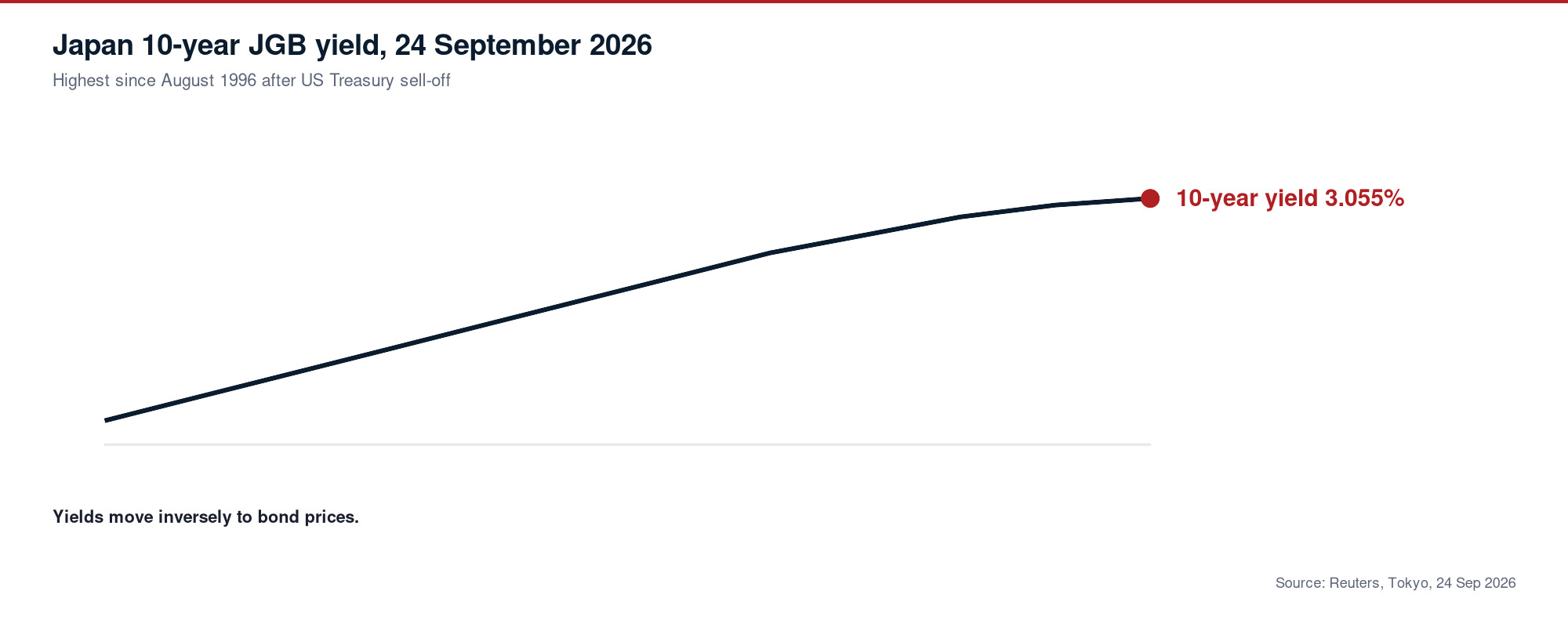
Reuters reported an 8 basis point increase to 3.055%. A basis point is one-hundredth of a percentage point, so eight basis points is a sharp single-day move by bond standards. The level itself, about 3.055%, is what Reuters described as the highest since August 1996.
The long end moved too. The 30-year yield rose 5.5 basis points to 4.125%. That tells you the sell-off was not only a short-maturity hiccup. Investors were demanding higher returns further out the curve as well.
Why the U.S. night session mattered
Bond markets are global. When U.S. Treasuries sell off overnight, yields rise in America and often drag other sovereign markets higher when Asia opens. Reuters cited that U.S. Treasury sell-off as a pressure source for the Tokyo move.
Weaker yen inflation concerns were the other named driver. A softer yen can raise import costs and keep inflation worries alive. The brief does not invent a yen level or a new CPI print. It records that those concerns sat in the same pressure mix as the U.S. sell-off.
For readers who only watch equities, the takeaway is simple. A rough night in U.S. bonds can show up as a rough morning in Japanese bonds. That is how the 24 September print arrived.
The early-September break already happened
Earlier in September, Japan's 10-year yield had already printed near or above 3% for the first time since 1996 during the global rout. So 24 September was not the first crack in the old ceiling. It was a confirmation that the break stuck and then pushed to a fresh 30-year high around 3.055%.
That sequence matters for false headlines. The story is not "Japan suddenly woke up at 3% with no warning." The story is a September global bond stress that first took the 10-year near or above 3%, then a U.S.-led overnight shock that lifted it further.
Households feel sustained high yields mainly through the cost of credit and through government refinancing, not through a single Tokyo fix. The brief does not invent a mortgage rate. It records government borrowing costs at multi-decade highs.
What not to believe
A yield high is not a default. Default would mean Japan failed to pay on schedule. A higher yield means investors are charging more to lend. Those are different events.
Also reject charts that erase the early-September context and pretend 3.055% arrived from nowhere. The brief already flags the earlier near-or-above 3% prints in the same month's global rout.
Stick to the linked Reuters report for dates and the exact prints. Market screens will keep updating. This article is pinned to the 24 September Reuters Tokyo read.
Who should care
Anyone tracking global bond stress, yen-linked inflation worries, or how U.S. Treasury moves transmit into Asia. Average readers need one breath: Japan's 10-year borrowing rate hit a roughly 30-year high after a U.S. sell-off, and that is a price of credit story, not a default story.
When a new headline lands, ask whether the yield print changed, whether a Bank of Japan policy step was announced, and whether the claim still matches "higher yields" rather than "Japan defaulted." Only hard prints and official decisions rewrite the file.
Sources: Reuters, 24 September 2026.