
A bond sell-off means prices fall and yields, the interest rate implied by those prices, rise. When sovereign yields rise, governments pay more to refinance old debt. Households feel it later through mortgages and credit if the higher rate climate sticks. Higher yields are not a synchronized sovereign default.
Reuters and the New York Times described the early September rout in plain markers: Japan's 10-year yield above 3% for the first time since 1996; Germany's 10-year at its highest in about 15 years; the UK at its highest since about 2007-2008; the US 10-year briefly near 4.8%. Later, on 24 September, Japan's 10-year printed about 3.055% after another US Treasury sell-off, a reminder the pressure did not vanish after the first week of the month.
TL;DR: Global government borrowing costs jumped in September 2026. Japan, Germany, the UK and the US all saw major yield markers. Drivers cited were inflation angst, energy and war risk, heavy debt issuance and central-bank signals. Your mortgage and your government's interest bill both care if yields stay high. This is not a mass default headline.
Status note: Checked 27 September 2026. Early-September markers follow Reuters and NY Times coverage dated 1 September 2026; the later Japan 3.055% print follows 24 September market reporting. Levels move daily.
What the markers said
Japan's 10-year above 3% was a three-decade event. Germany's 10-year at a roughly 15-year high mattered because German paper is the euro-area benchmark. The UK at highs last seen around the 2007-2008 era signalled gilt stress in the same global wave. The US 10-year briefly near 4.8% set the tone overnight for many other markets. None of those prints require inventing a single "world average" yield.
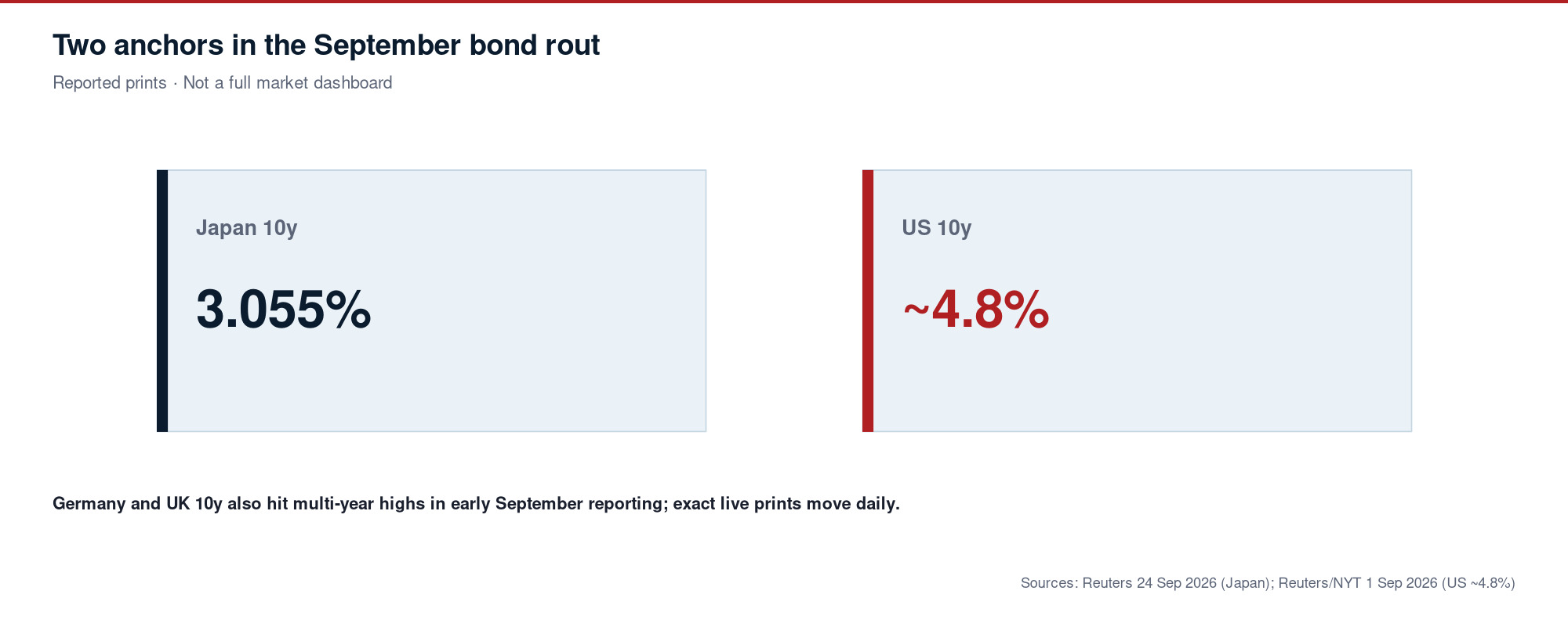
By 24 September, Japan's 10-year at about 3.055% showed the sell-off still had legs after US Treasuries sold off again. Keep that as a high-level sequel, not a second full Japan explainer.
Why yields rose together
Reporting cited inflation angst, energy and war risk, government debt supply and central-bank signals. Sticky inflation makes investors demand higher yields so their returns are not eaten by rising prices. War and energy shocks feed that inflation worry. Heavy issuance means governments are selling a lot of new bonds; more supply can push prices down and yields up. Hawkish or hike-ready central banks reinforce the move.
Those drivers can overlap. Soften any claim that pins the whole rout on one cause alone when the cited list is plural.
How households and budgets feel it
Governments refinance maturing debt at the new higher yields, so interest costs climb over time. Households feel sovereign yield spikes through mortgage rates, car loans and other credit that tracks the broader rate environment when the move lasts. The brief does not invent a specific mortgage rate for each country. The mechanism is enough: higher government yields, tougher borrowing climate.
Serious readers watching fiscal space should care because a bigger interest bill crowds other spending. Casual readers should care because "bond rout" is not only a trader hobby when credit prices follow.
What not to believe
Higher yields are not a synchronized sovereign default. Reject headlines that say Japan, Germany, the UK and the US all failed to pay because yields rose. A yield is the price of borrowing. Defaults are a different legal and political event, and none is in this brief. Also do not invent a precise next Fed, ECB, BOE or BOJ date from the rout alone.
Hold the useful middle: September 2026 was a real global rise in government borrowing costs, with clear country markers and named drivers, and with household and budget consequences if the level sticks. Panic default copy is the false version.
Sources: Reuters, 1 September 2026; NY Times, 1 September 2026.