
A basis point is one-hundredth of a percentage point. So 104 basis points means French 10-year government debt yields about 1.04 percentage points more than Germany's. That is the market's price for France's extra perceived risk. It is a borrowing-cost story, not a bankruptcy headline.
The move lands in a month when European yields were already elevated in a global bond rout. Politics and budgets sit under the number. So does the simple fact that debt interest is already France's biggest budget expense, according to the Reuters explainer behind this piece.
TL;DR: France's 10-year yield sat 104 basis points over Germany's, the first full-percentage-point premium since 2012. The spread has roughly doubled since the 2024 snap election fractured parliament and made deficit cuts harder. Debt servicing is already France's largest budget outlay. Wider spreads raise the cost of refinancing. They are not a formal default notice.
Status note: Checked 27 September 2026. Spread levels move with every trading session. Treat any "France has defaulted" claim as false unless a primary issuer statement says so. Core facts follow the Reuters reporting linked below.
What the 104 figure means
Bond traders watch the French-German 10-year spread as a euro-area stress gauge. Germany is the usual safe benchmark inside the currency union. When France pays a bigger premium over that benchmark, investors are demanding more compensation to hold French debt.
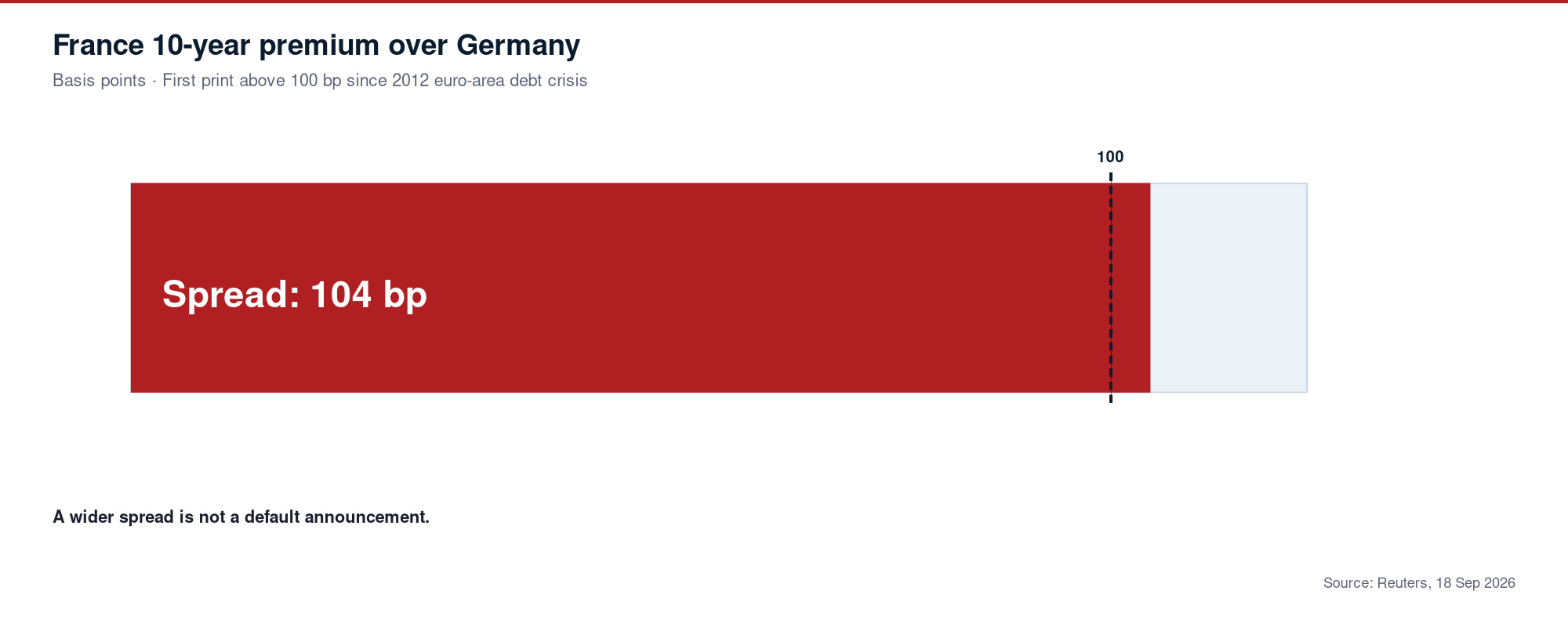
Reuters reported the premium at 104 basis points, above a whole percentage point for the first time since 2012. That 2012 echo matters for memory, not for copying the old crisis script. Markets can price stress without repeating every chapter of the euro-area debt crisis.
For households and firms, the path from a government spread to daily life is indirect. Higher sovereign yields can feed into the cost of credit across the economy over time. The brief does not invent a mortgage rate change. It records a government risk premium that has moved to a 2012-style high.
How politics widened the gap
Reuters ties the doubling of the spread to the period after France's 2024 snap election fractured parliament. A fractured parliament makes clean deficit-cutting deals harder. Harder fiscal repair is exactly the kind of story bond markets price into a wider premium.
That is the mechanism in plain English. Investors care whether a government can pass and stick to budget plans. When the legislature is fragmented, the market often asks for a higher yield. The brief does not invent a new election date or a new deficit target. It records that the spread doubled in that political stretch.
Readers outside France still feel euro-area bond stress when continental yields rise together. September's global bond rout is the broader backdrop. France's premium over Germany is the country-specific layer on top of that.
Debt interest already bites the budget
Per the Reuters explainer, debt servicing is already France's biggest budget expense. That sentence is why a rising risk premium is not an abstract chart for finance nerds only. When the state already spends more on interest than on other single budget lines, a higher yield makes the next refinancing round more expensive.
None of that equals a default announcement. Default would be a failure to pay on schedule. A wider spread is the market's warning price, not a legal notice that payments have stopped.
If you see social posts claiming Paris has "gone bankrupt" because the spread crossed 100 basis points, that is the false version. The verified step is a market premium at 104 basis points on the reporting date, with political and fiscal stress as the cited drivers.
What not to believe
A wider spread is not a French default announcement. It is also not proof that the euro is ending, or that Germany has "abandoned" France. Those leaps are narrative tourism. Stick to the linked Reuters piece for dates and scope.
Also reject the claim that nothing has changed since 2024. The brief says the spread doubled since the snap election fractured parliament. That is a material move, even if it is still a market price rather than a courtroom event.
Who should care
Anyone watching euro-area bond stress, French budget politics, or how September's global yield jump shows up in national risk premia. Average readers need one breath: France now pays more than a percentage point extra versus Germany to borrow for 10 years, first time since 2012, and that is a cost signal, not a default notice.
When the next headline appears, ask three questions. Did the spread print move? Was a new budget vote or rating action published? Does the claim still match "wider premium," or has someone upgraded it to "default"? Only the first two kinds of updates rewrite the story. The third is noise until a primary source catches up.
Sources: Reuters, 18 September 2026.