At its 17-18 September meeting the BOJ voted 7-2 to encourage the uncollateralized overnight call rate around 1.25%, up from around 1.0%. The new guideline took effect on 24 September. Reuters described the level as a 31-year high for the policy rate.
Do not invent a terminal rate. Analysts guess; the Bank has not locked one. Reuters also noted this was the first time since 1990 that the BOJ hiked after only about three months.
TL;DR: The BOJ hiked to around 1.25% by a 7-2 vote. Toichiro Asada and Ayano Sato dissented. The change took effect 24 September. Ueda says policy is now more about keeping inflation near 2% and avoiding an overshoot. The Bank flagged Middle East risk, AI-related demand and the exchange rate as upside inflation risks.
Status note: Checked 27 September 2026. The 18 September statement and the 24 September effective date are fixed. Future hike size and timing are not. Ignore charts that invent a final "terminal" rate as if the BOJ published one.
The vote and the new rate
Japan's policy rate is steered through the uncollateralized overnight call rate, the overnight rate banks charge each other without posting collateral. The Monetary Policy Meeting decided to encourage that rate around 1.25%, up from around 1.0%.
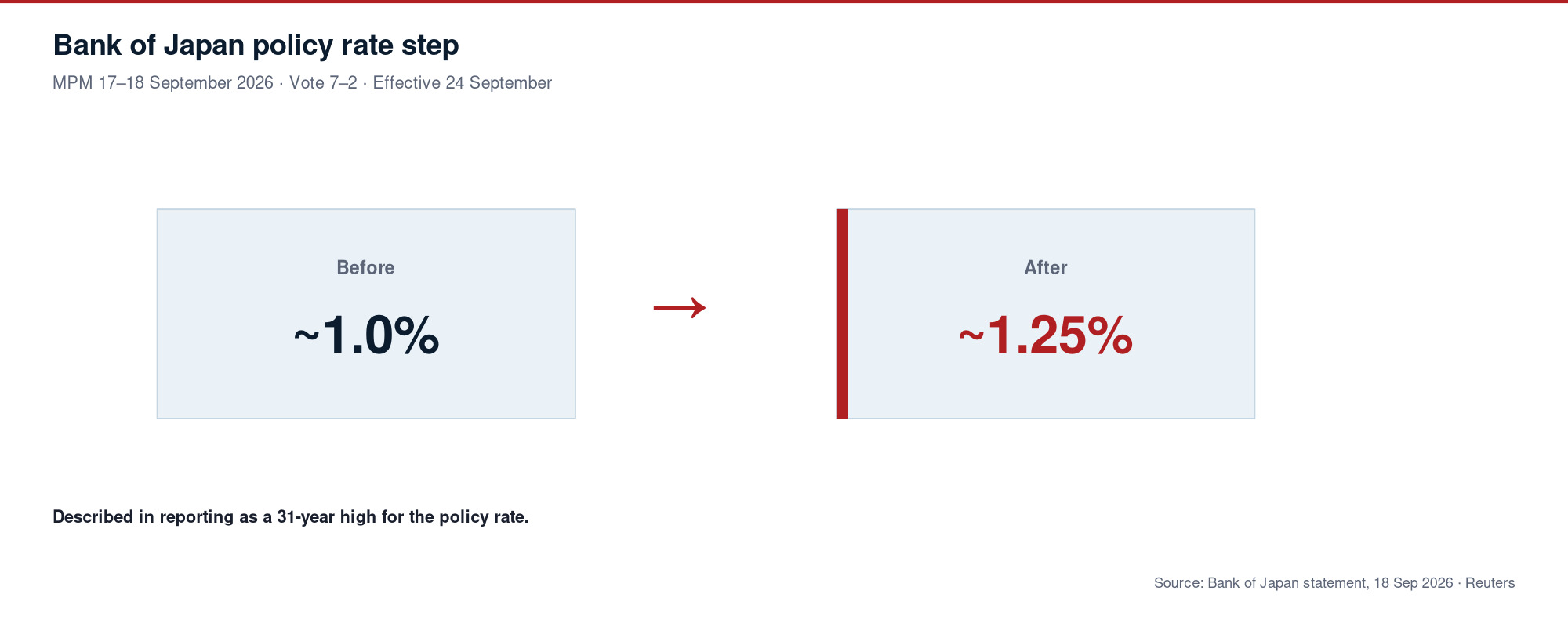
The vote was 7-2. Dissenters were Toichiro Asada and Ayano Sato. Naming dissenters matters because it shows the board was not unanimous. The majority still carried the hike. The Bank's statement said the new guideline was effective 24 September 2026.
That lag between decision day and the effective date is normal for the BOJ's operational change. Markets price the decision when it lands. Banks implement the new overnight target when the guideline starts.
Why "31-year high" matters
Reuters reported this as a 31-year high for the policy rate, and the first time since 1990 that the BOJ hiked after only about three months. For years Japan lived with near-zero or negative rates. A move to 1.25% is small by global standards, but large in Japan's recent history.
Households and firms that borrowed for decades in a near-zero world feel each step more than a headline number suggests. That is why the pace, not only the level, is news. A quick follow-up hike after a prior move signals less patience than the old ultra-slow playbook.
Still, "31-year high" is a description of the policy rate level. It is not a claim about mortgage pain for every borrower, and it is not a forecast of the next stop.
Ueda's phase shift
Ueda said the policy phase had changed toward stabilizing inflation near 2% and avoiding an overshoot. In plain English: the Bank is less focused on lifting inflation up, and more focused on keeping it from running hot.
Two percent is the inflation goal many major central banks use as a yardstick. An overshoot means prices rising faster than that goal for long enough to worry the Bank. Ueda's language puts prevention, not stimulus, closer to the centre of the story.
The statement flagged Middle East developments, AI-related demand, and foreign-exchange moves as upside inflation risks. Upside risk means prices could rise faster than expected. FX, the foreign-exchange rate, matters because a weaker yen can raise the cost of imports priced in other currencies.
What the Bank has not said
There is no published terminal rate in the brief. A terminal rate would be the peak policy rate in a tightening cycle. Commentators will float numbers. Those are guesses unless the BOJ writes them down.
What is on the record is the 1.25% guideline, the 7-2 vote, the 24 September start, the dissent names, the 31-year-high description from Reuters, the roughly three-month gap since the prior hike, and Ueda's overshoot warning. That is enough to understand the turn without inventing the finish line.
If a social post claims Japan has "ended cheap money forever" or names a final rate the Bank never published, treat it as speculation. The useful story is simpler: rates are at a multi-decade high for this tool, the hike came faster than Japan's old rhythm, and the governor says the job now includes stopping inflation from overshooting 2%.
Sources: Bank of Japan statement, 18 September 2026; Reuters via Euronext live, 18 September 2026.