
Kpler data reported via CNBC and SEE News put September's average near 6 million barrels per day. That was the highest since the war began about seven months earlier, and broadly in line with the 2025 monthly average. August had averaged about 3.4 million bpd, so September was up nearly 80% from that trough.
Do not read the rebound as proof that Strait of Hormuz risk has disappeared. The East-West pipeline had been a Hormuz bypass to the Red Sea before a drone attack from Iraq shut it. Export recovery and chokepoint risk can exist at the same time.
TL;DR: Saudi seaborne crude bounced to roughly 6 million bpd in September after a weak August near 3.4 million bpd, up nearly 80% from that trough. The East-West line was hit and shut; industry sources later told Reuters it resumed at reduced rates, though Saudi authorities had not publicly confirmed. Brent briefly traded near $110 after the shutdown, then eased as the disruption looked less severe. Aramco's CEO said temporary infrastructure hits typically last days. Stronger Saudi loadings are not an all-clear on Hormuz.
Status note: Checked 27 September 2026. September averages are from Kpler via CNBC/SEE reporting. Pipeline restart details remain partly based on industry sources, not a full public Saudi confirmation in the brief. Hormuz and pipeline status can change with the next incident.
The September rebound
Six million barrels a day is a flow measure of how much Saudi crude left by sea, averaged across September. Kpler's figure sits near the 2025 monthly average and well above August's roughly 3.4 million bpd. Nearly 80% up from August is the recovery math in the brief.
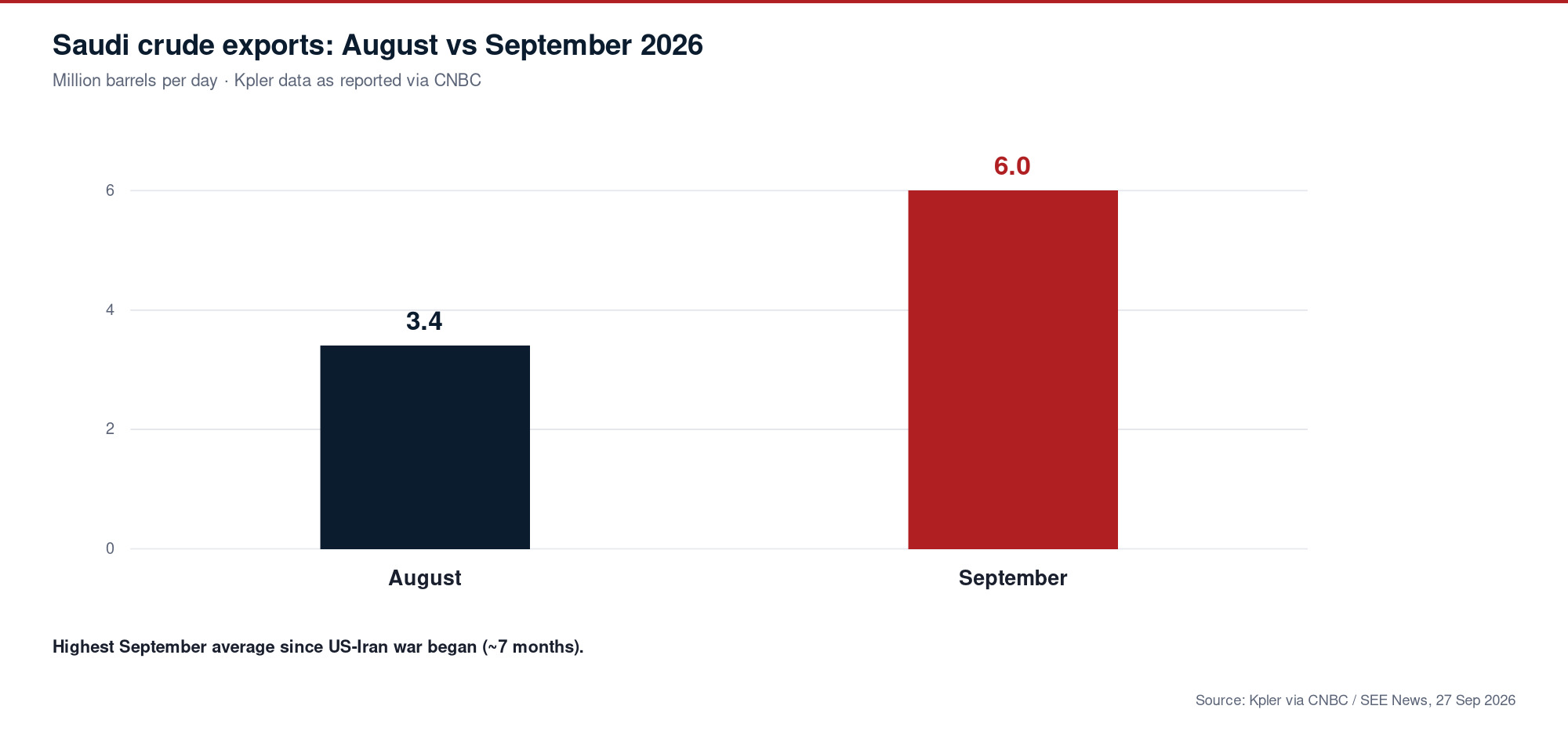
That bounce is why "Saudi exports collapsed for good" takes failed. August looked stressed. September looked much healthier on the Kpler average. Broadly matching the 2025 monthly average also matters: this is a return toward a familiar pace, not a claim of a brand-new peacetime record invented outside the brief.
For oil desks, the comparison that counts is wartime September versus wartime August, and versus the 2025 monthly average benchmark. The war is about seven months old in the reporting frame. Highest since the war began is the Kpler ranking, not a promise that every future month stays there.
The East-West pipeline hit
The East-West pipeline moves oil across Saudi Arabia toward the Red Sea, a route that can bypass Hormuz when the Gulf outlet is risky. It was shut after a drone attack from Iraq. That shutdown mattered because it removed a safety valve just when Gulf shipping risk was already high.
Industry sources told Reuters the pipeline resumed at reduced rates earlier in the week of the report. Saudi authorities had not publicly confirmed that restart in the material cited. Treat "fully normal" as unverified. Reduced rates are better than a full shut, and still not the same as an untouched bypass.
Readers should hold the sequencing. Hit and shut. Price spike. Later talk of a reduced-rate restart from industry sources. Public Saudi confirmation absent in the brief. That is the evidence ladder; do not skip rungs.
What prices did
Brent crude, the global oil benchmark, briefly traded near $110 a barrel after the shutdown. It later retreated as the disruption looked less severe. Price spikes on infrastructure news often fade if spare routes or quick repairs show up. They can return if the next strike lands harder.
Aramco CEO Amin Nasser told Nikkei that temporary infrastructure disruptions typically last days. That is a company view about typical outages, not a guarantee for every wartime hit. Markets heard the calm tone after the spike; they still have to watch the next drone or tanker incident.
The brief does not invent a closing Brent print for 27 September. It records the brief near-$110 spike and the later retreat as the disruption looked less severe.
What the rebound does not settle
Stronger Saudi exports ease one supply scare. They do not cancel Hormuz exposure for the wider Gulf system. A bypass line running at reduced rates is not the same as a fully open, low-risk map.
False headlines will say the war's oil shock is over because Saudi loadings recovered. The verified pair is different: September Saudi seaborne crude looks much stronger than August on Kpler, and strategic risk around Hormuz and cross-kingdom pipelines is still live.
For energy readers and anyone paying fuel prices, hold both facts. Higher export averages are good news for barrels available. They are not an all-clear siren. Watch Kpler-style flow data, pipeline confirmation from Riyadh if it comes, and whether the next incident hits the bypass again or the Gulf outlet itself.