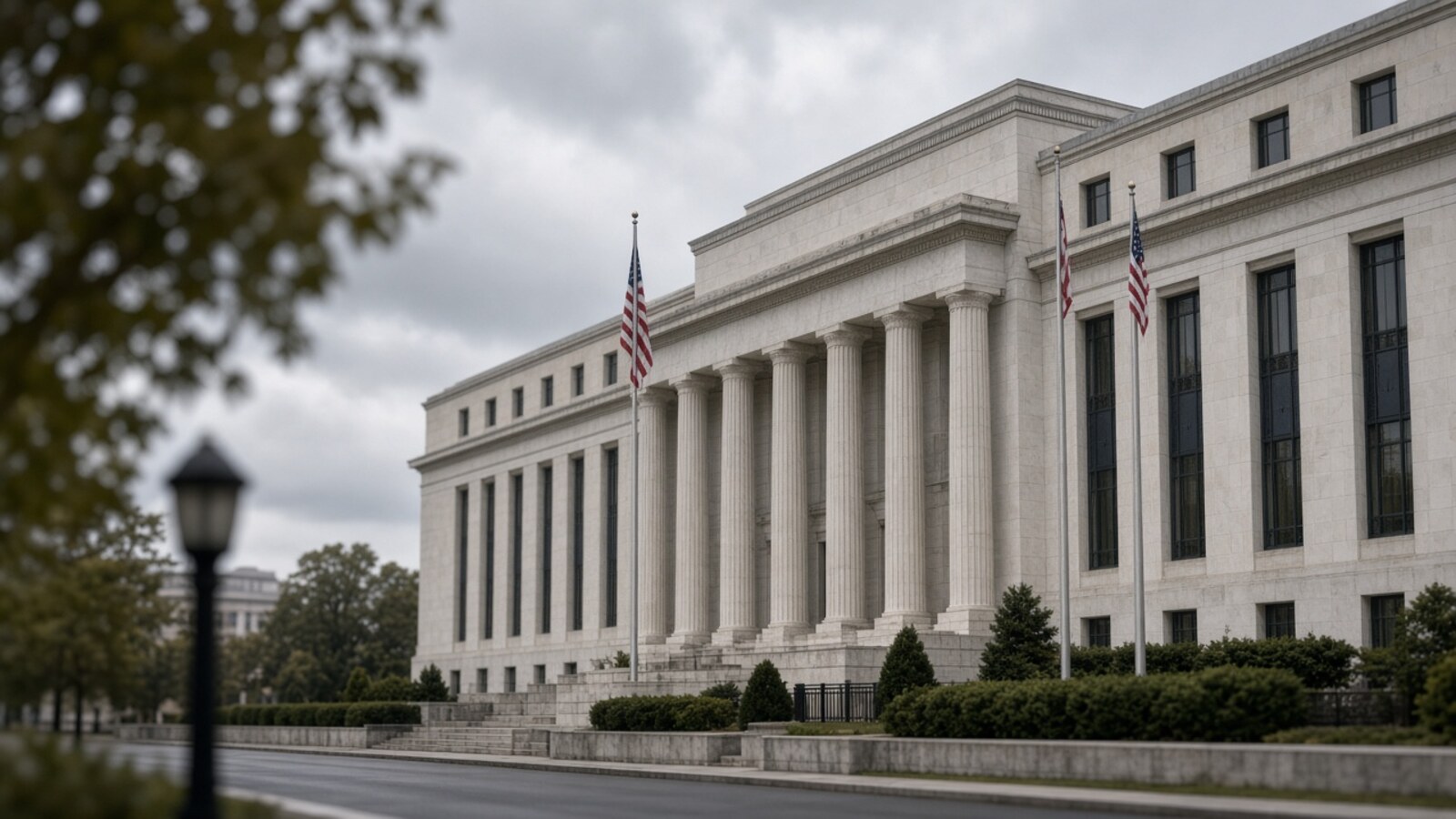
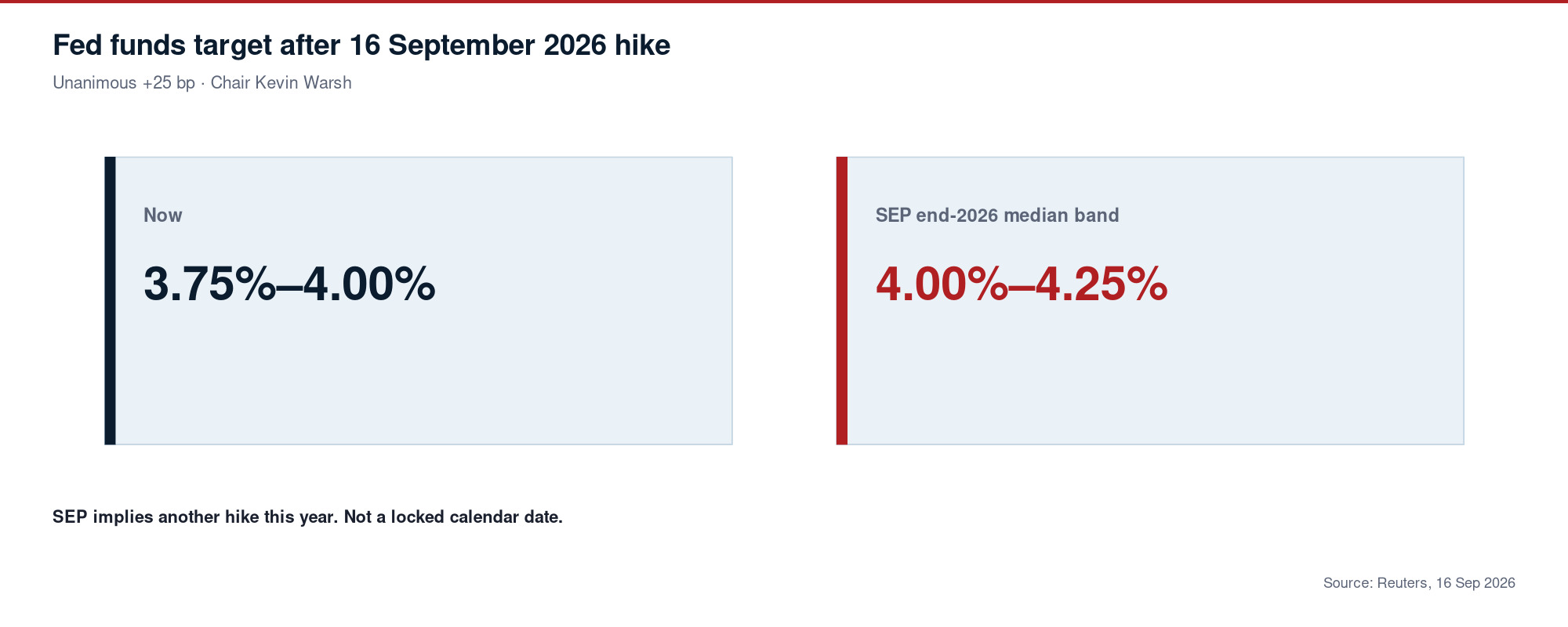
The Fed voted unanimously for a 25 basis-point hike, lifting the federal funds target to 3.75%-4.00%. A basis point is one-hundredth of a percentage point, so this was a quarter-point move. Reuters reported the decision as unanimous.
Warsh said inflation remains elevated and that the action supports a timelier return to the 2% goal. Do not invent a precise next hike date. Officials penciled another hike this year; markets will still move the odds around meeting by meeting.
TL;DR: The Fed hiked a quarter point to 3.75%-4.00% on 16 September 2026. All voters agreed. Warsh says inflation is still high and financial conditions are hard to call restrictive. Officials' forecasts imply another hike by end-2026, with the long-run rate marked up slightly to 3.2%. Activity looks solid; domestic spending and capital investment are holding up in the statement's language.
Status note: Checked 27 September 2026. The 16 September decision and Summary of Economic Projections are published. Markets can reprice the next meeting anytime. This piece does not pin a calendar date for the next hike.
What the Fed did
On 16 September 2026 the Federal Open Market Committee raised the federal funds target range to 3.75%-4.00%. The federal funds rate is the overnight rate banks charge each other. It is the Fed's main steering tool for money conditions in the wider economy.
The statement said economic activity was expanding at a solid pace. Domestic spending looked resilient. Capital investment was upgraded to robust. In plain terms: the committee still sees a busy economy, not one collapsing under higher rates.
That backdrop helps explain why the Fed felt able to hike. If spending and investment look firm while inflation stays high, waiting can look riskier than moving another quarter point.
What Warsh emphasised
Chair Kevin Warsh said inflation remains elevated. He argued the hike supports a timelier return to the Fed's 2% inflation goal. Two percent is the long-standing target for how fast prices should rise on average over time.
He also said financial conditions are hard to call restrictive. Financial conditions means the mix of interest rates, credit access and market pricing that shapes borrowing. If that mix is not truly "tight," the Fed may feel it still has work to do even after this hike.
Warsh's wording is as important as the rate number for markets that trade every speech. The hike itself was a clear action. The inflation message is what keeps another move on the table.
What the forecasts say
In the Summary of Economic Projections, often called the SEP or the "dot plot" story in markets, officials see the policy rate in a 4.00%-4.25% range by end-2026. That implies another hike this year if the median path holds. The end-2027 view was unchanged. The longer-run rate was marked up to 3.2% from 3.1%.
Those projections are not promises. They are each official's written guess at the time of the meeting. A soft inflation print or a sharp slowdown could rewrite them. Treat "another hike this year" as the committee's penciled path, not a locked calendar appointment.
The small uptick in the long-run rate, from 3.1% to 3.2%, is easy to miss. It signals officials see a slightly higher "normal" rate when the dust settles, not a dramatic regime change on its own.
What not to overread
A unanimous vote shows agreement for now. It does not freeze dissent forever. The solid-activity language also does not mean every household feels rich. It means the Fed sees enough demand and investment to keep leaning against inflation.
If you see a viral post naming the exact day of the next hike, skip it. Reuters' coverage of the decision and the SEP is the baseline: one hike done, another penciled before year-end, inflation still the problem Warsh is naming out loud.
For borrowers and savers, the practical takeaway is simpler than the jargon. The overnight policy range is now 3.75%-4.00%. The chair says prices are still rising too fast relative to the 2% goal. Officials' own forecasts leave room for one more hike in 2026, and they nudged up their long-run rate guess by a tenth of a point.
Sources: Reuters, 16 September 2026; Reuters SEP coverage, 16 September 2026.