
Germany’s 30-year government bond yield has reached 3.79% - its highest level since 2011. That is a significant change for the country traditionally treated as the eurozone’s benchmark borrower.
It does not mean Germany is unable to borrow. It does not mean the euro is about to collapse. But it does tell us that Europe’s debt market is changing - and investors now want a higher return for lending to governments over long periods.
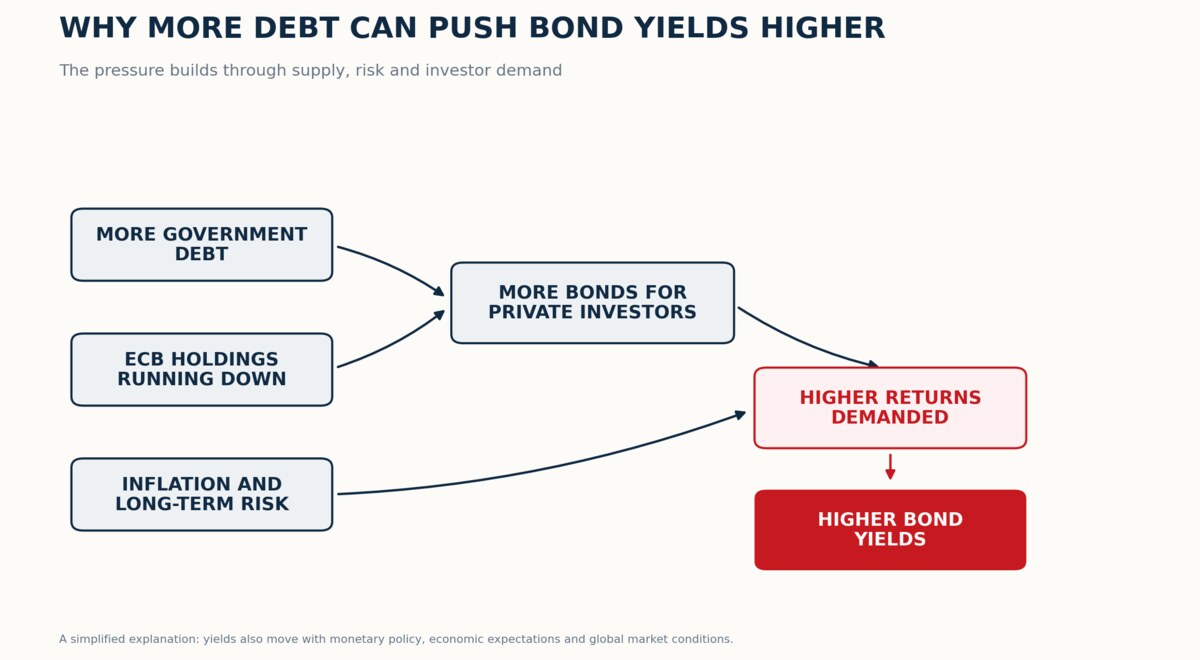
The immediate story is German borrowing. The bigger story is the amount of debt coming onto European markets while one of the largest historic buyers, the European Central Bank, continues to reduce its holdings.
Germany’s 30-year yield reaches a 15-year high
On 18 August, Germany placed a 30-year federal bond at an average yield of 3.783%. The following day, the market yield touched approximately 3.79%, its highest level since 2011.
Bond yields and bond prices move in opposite directions. When investors sell bonds - or demand greater compensation before buying them - the price falls and the yield rises.
Several pressures have been operating at once:
-
Germany is issuing more debt.
-
Other European governments and companies are also raising large amounts of money.
-
The ECB is no longer reinvesting proceeds from bonds that mature under its major purchase programmes.
-
Energy and inflation concerns associated with the Iran war have placed additional pressure on long-term yields.
-
Investors are becoming more cautious about holding debt for 20 or 30 years.
It would therefore be misleading to blame the entire increase on German spending alone. Supply matters, but so do inflation expectations, central-bank policy and global market conditions.
Germany is borrowing substantially more
Germany plans to issue approximately €518 billion in federal securities during 2026, excluding some additional syndications. That compares with total issuance of €425 billion in 2025.
Those figures require context. The €518 billion total includes short-term money-market instruments as well as longer-term federal bonds. It is not Germany’s annual budget deficit, and it is not all new long-term debt. Governments continually issue securities both to finance current budgets and to replace debt that is reaching maturity.
Reuters cited a Commerzbank estimate that German government bond supply could reach a record €400 billion in 2027, compared with an estimated €349 billion in 2026. That 2027 figure is a bank forecast - not an official final issuance programme.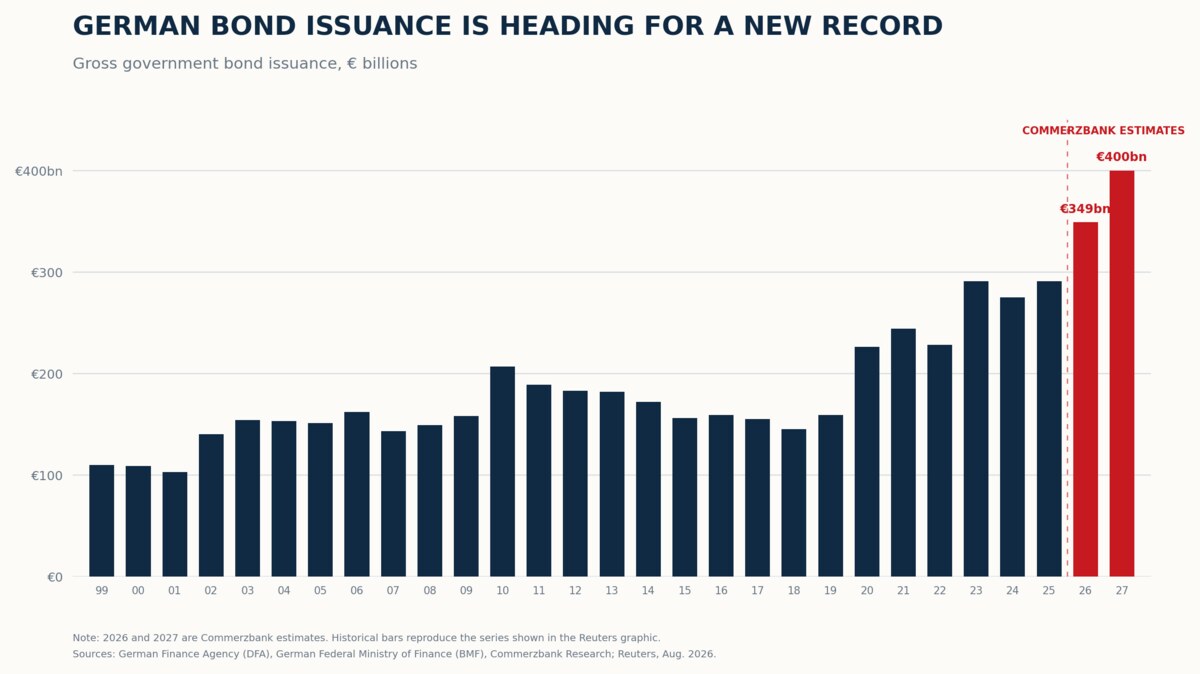
The direction, however, is clear. Germany is moving away from the era in which strict fiscal rules and limited issuance created a relative scarcity of German government bonds.
Germany Is Issuing More Debt
| Year | Federal securities issuance |
|---|---|
| 2025 actual | €425B |
| 2026 planned | approximately €518B |
2026 planned federal securities issuance, including money-market instruments. Some additional syndications excluded.
A soft 10-year auction added to the concern
Germany’s 19 August 10-year bond reopening provided another signal that investors are becoming more selective.
The announced issuance volume was €6 billion. Total bids reached €4.334 billion, and Germany allotted approximately €3.769 billion to bidders. The bid-to-offer ratio was 0.7.
Calling this a complete auction failure would be inaccurate. Germany retained approximately €2.231 billion of the issue, and the German Finance Agency routinely retains portions of securities for later use in secondary-market operations.
Nevertheless, bids below the announced issue size represented soft demand. Investors were still willing to buy German debt - but not in unlimited quantities at any price.
Why is Berlin borrowing more?
Germany’s shift is deliberate. Berlin is increasing spending on defence, infrastructure and economic modernisation after years of weak investment and sluggish growth.
The country has established a €500 billion special fund for infrastructure and climate neutrality. This is a multi-year borrowing authorisation, not €500 billion of spending in a single year.
Germany has also changed its fiscal framework to create more room for defence expenditure. The government argues that greater security spending is necessary following Russia’s invasion of Ukraine, while investment in transport, energy and public infrastructure is intended to strengthen an economy that expanded by only 0.2% in 2025.
The case for that investment may be strong. But the bond market still has to absorb the borrowing used to finance it.
This is bigger than Germany
Germany is not borrowing in isolation. Eurozone governments continue to finance defence, ageing populations, healthcare, infrastructure and the lingering fiscal effects of recent crises.
Barclays has forecast that gross eurozone bond supply could reach a record €1.54 trillion in 2027. Because that number is a projection, it may change as governments finalise their budgets and issuance programmes.
The same forecast put net issuance - the amount remaining after maturing debt is taken into account - at approximately €574 billion, slightly below the expected 2026 level.
France is likely to receive particular scrutiny. Reuters reported that French long-term yields were approaching 5%, close to their highest levels in 18 years, while its deficit was expected to remain above 5% amid political difficulty agreeing on budget measures.
The ECB is stepping back as a buyer
For years, the European Central Bank and national central banks absorbed large amounts of government debt through asset-purchase programmes.
That support is now running down. Reinvestments under the ECB’s Asset Purchase Programme ended in July 2023. Reinvestments under the Pandemic Emergency Purchase Programme ended after December 2024.
The ECB is therefore allowing bonds to mature without replacing them. This does not mean the ECB has abandoned the bond market or could never intervene again. It means private investors must absorb more of the securities being issued while the central bank’s existing portfolio gradually shrinks.
When the supply of bonds rises faster than investor appetite, yields generally need to increase to attract buyers.
What could higher yields mean for ordinary people?
Government bond yields do not instantly determine every mortgage or business-loan rate. The transmission differs between countries, banks and loan products.
But government bonds provide important reference rates across financial markets. Persistently higher yields can:
-
increase the cost of new government borrowing;
-
gradually lift government interest expenses as older debt is refinanced;
-
influence corporate borrowing and bank funding costs;
-
place upward pressure on some mortgage and business-loan rates;
-
reduce the future budget room available for services, tax relief or new spending; and
-
lower the market value of existing fixed-rate bonds.
The effect on government budgets is gradual because countries do not refinance their entire debt stock at once. But if higher yields persist for years, the additional interest burden accumulates.
Europe can still borrow - but at what price?
Germany remains one of the world’s strongest sovereign borrowers. A 3.79% 30-year yield is not evidence of insolvency, and one soft auction does not constitute a debt crisis.
The warning lies elsewhere.
Germany and the wider eurozone are preparing to sell more debt at the same time that central-bank portfolios are shrinking and investors are demanding greater compensation for long-term risk.
Europe can still finance defence, infrastructure and public services. The real question is how much those priorities will cost - and how much future government revenue will be committed to interest before it can be spent anywhere else.
Published by Alex Morgan Unfiltered. Market figures and forecasts are current as at 23 August 2026. Forecasts are estimates and may change.