TL;DR: T&E says EU battery electric vehicle (BEV) sales hit 1.64 million in January to August 2026, up 45% year on year, with a 22% market share, up six points from the same stretch in 2025. August's BEV share reached 28%. Q2 2026 was the first full quarter BEVs outsold pure petrol. European makers held seven of the ten best-selling BEV models and about 60% of available models, with Chinese brands at 21%. France and Germany drove roughly half of bloc BEV sales in the first half; August shares hit 38% in France and 32% in Germany. Diesel is up 38% since the Iran war began, about €30 more for a 50-litre tank. T&E warns weakening 2030 to 2035 CO2 targets would slow affordable EVs. This is advocacy analysis, not Eurostat.
Status note: Checked 6 October 2026 against Transport & Environment's EV progress report of 5 October 2026. Official registration tallies, national incentive changes, and EU CO2 law votes can still shift the picture. Attribute sales shares and model counts to T&E unless a statistical office republishes them.
What the numbers say
Transport & Environment, often shortened to T&E, is a Brussels-based green transport advocacy group. Its 5 October report argues EU car CO2 rules are already forcing manufacturers to sell more battery electrics. Battery electric vehicles, or BEVs, run only on a battery, not a petrol or diesel engine.
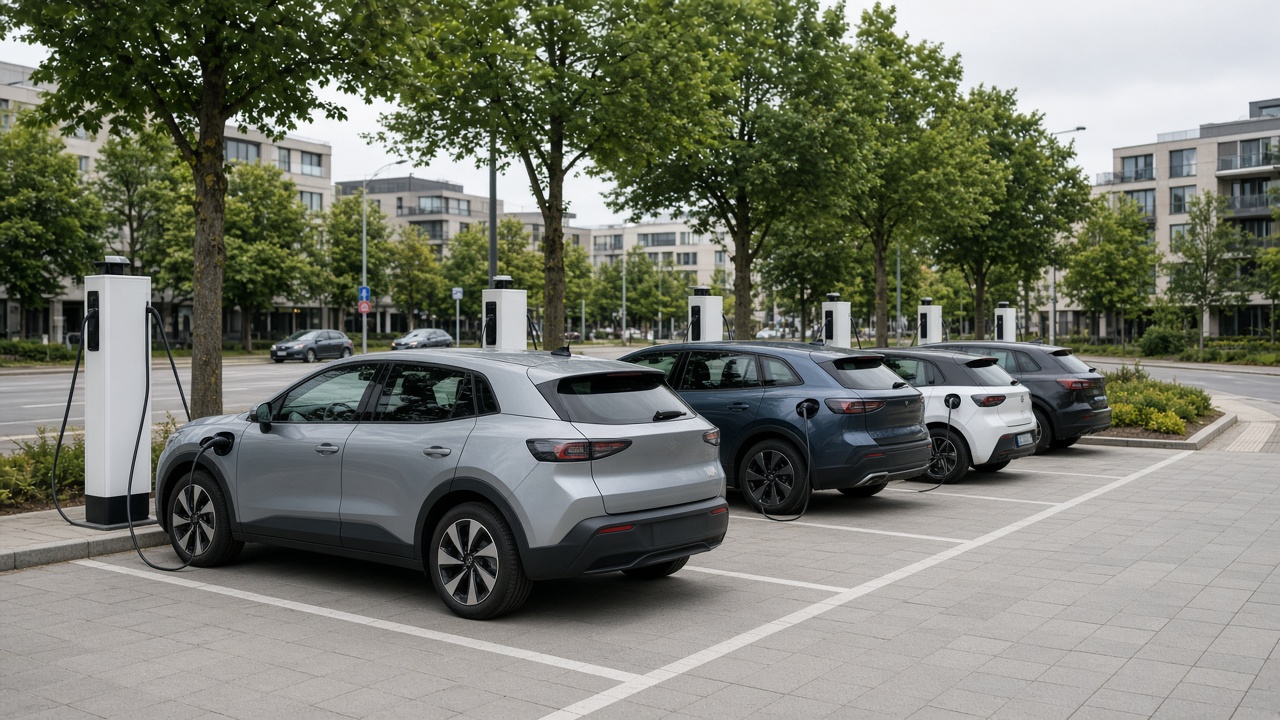
From January to August 2026, T&E counted 1.64 million BEV sales in the EU, 45% more than a year earlier. The BEV share of new cars in that period was 22%, six percentage points higher than the same months in 2025. In August alone the share reached 28%. In the second quarter of 2026, BEVs outsold pure petrol cars for the first time over a full quarter, at a 22% share in that comparison.
Who is selling, and where
European carmakers accounted for seven of the ten best-selling BEV models, T&E said. About 60% of available BEV models were European; Chinese makers held 21% of the model lineup. That is a catalogue share, not a claim that Chinese brands are failing on volume everywhere.
France and Germany together made up around half of the bloc's BEV sales in the first half of 2026. By August, BEV market shares in those countries reached 38% in France and 32% in Germany. Italy and several eastern EU markets posted fast percentage growth from a smaller base, with some still in single-digit shares.
T&E also says about 60 new BEV models are expected by the end of 2026, nearly four times the recent yearly average, and that models priced under €25,000 are set to jump sharply versus 2024. Those forecasts are the group's projections, not finished sales.
Oil shock at the pump, and the CO2 fight
The report ties part of the EV surge to expensive fuel after the Iran war. Diesel is up 38% since that war began, T&E said, with a 50-litre tank costing about €30 more. Home-charged electric cars were described as costing about 50% less to run than petrol and diesel as of mid-September 2026. Drivers who stay on diesel feel the war at the pump; EV buyers are partly voting with their wallets.
Halfway through the 2025 to 2027 CO2 compliance window, T&E says carmakers have closed about 75% of the gap to their three-year targets and that half the market is already meeting them. The political fight now is the 2030 to 2035 review. T&E warns that proposals to weaken those targets, including what it calls the EPP/Salini line in the European Parliament, would stall BEV share near today's levels instead of the much higher path under current law, and would cut sales of cheaper under-€25,000 electrics hard. That is an advocacy warning aimed at co-legislators, not a finished vote result.
Where things stand
The core fact for readers: EU battery EV sales and share jumped in the first eight months of 2026 on T&E's count, European brands still dominate many bestsellers, and France and Germany are carrying a large share of the volume. Diesel pain since the Iran war is part of the demand story the group tells.
What this is not: an official Eurostat bulletin, proof that every national market has flipped, or a final EU decision on 2030 to 2035 CO2 rules. Social posts that treat the report as Brussels statistics, or as a finished end to petrol cars next year, oversell the source. Watch registration agencies and the autumn CO2 negotiations for the next hard updates.
Sources: Transport & Environment EV progress report, 5 October 2026.