
President Donald Trump says unfavourable polls are wrong. The question that can be checked is simpler: where does he stand in the numbers available in late August 2026?
The picture is split. Inside the Republican Party his support is still very strong. Nationally he is about 20 points underwater. Democrats lead the generic congressional ballot by six to seven points. The House currently favours Democrats. The Senate is a toss-up, and Republicans still have the easier Senate path.
That is not a collapse. It is a midterm warning. The polls can move. As of today, they do not show what he says they show.
Two electorates
Polling averages in August put Trump’s net job approval near −20, roughly 38 percent approve and 58 percent disapprove. Most national polls still show Republican approval around 80 percent.
One Reuters/Ipsos survey, fielded 21-24 August, was weaker than the average: 33 percent approval among all adults, and 82 percent among Republicans. That poll is real. It is not the average. This article uses the average for the national figure.
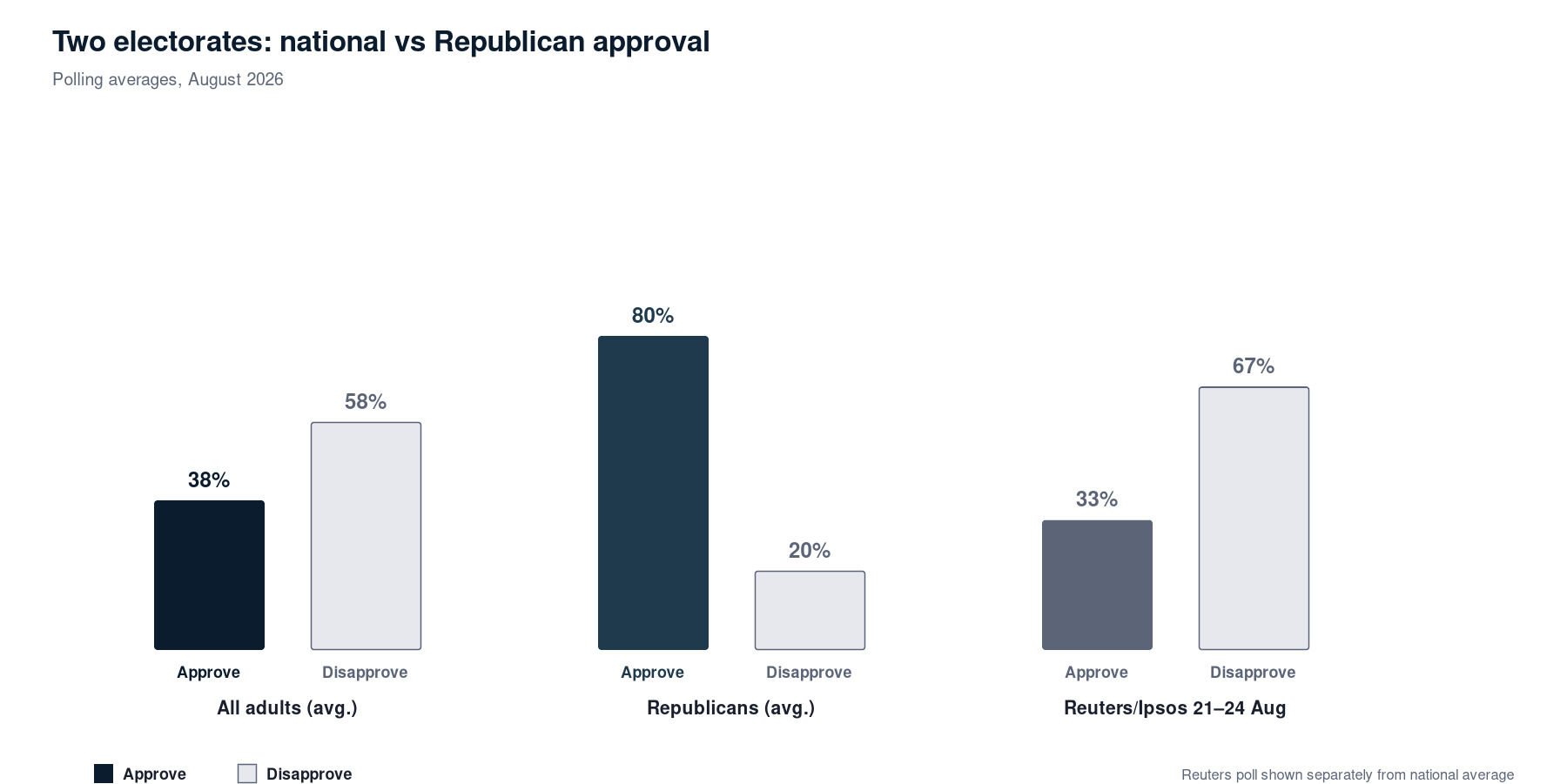
A president can hold his party and still make life harder for candidates in swing districts. The live question is not whether Republicans still back Trump. It is whether enough voters outside that base will back Republican House and Senate candidates in November.
The generic ballot
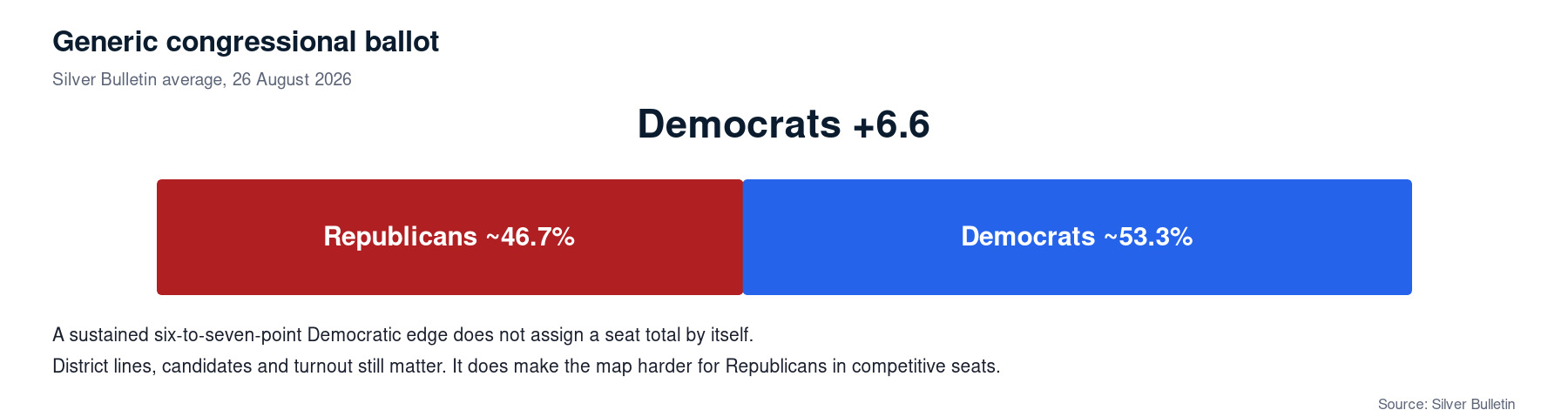
The generic ballot asks which party a voter wants in Congress, not which named candidate.
Silver Bulletin’s 26 August average had Democrats ahead by 6.6 points. That lead barely moved through August. A sustained six-to-seven-point Democratic edge does not assign a seat total by itself. District lines, candidates and turnout still matter. It does make the map harder for Republicans in the seats that are actually in play.
Why the House favours Democrats
All 435 House seats are up. Control requires 218.
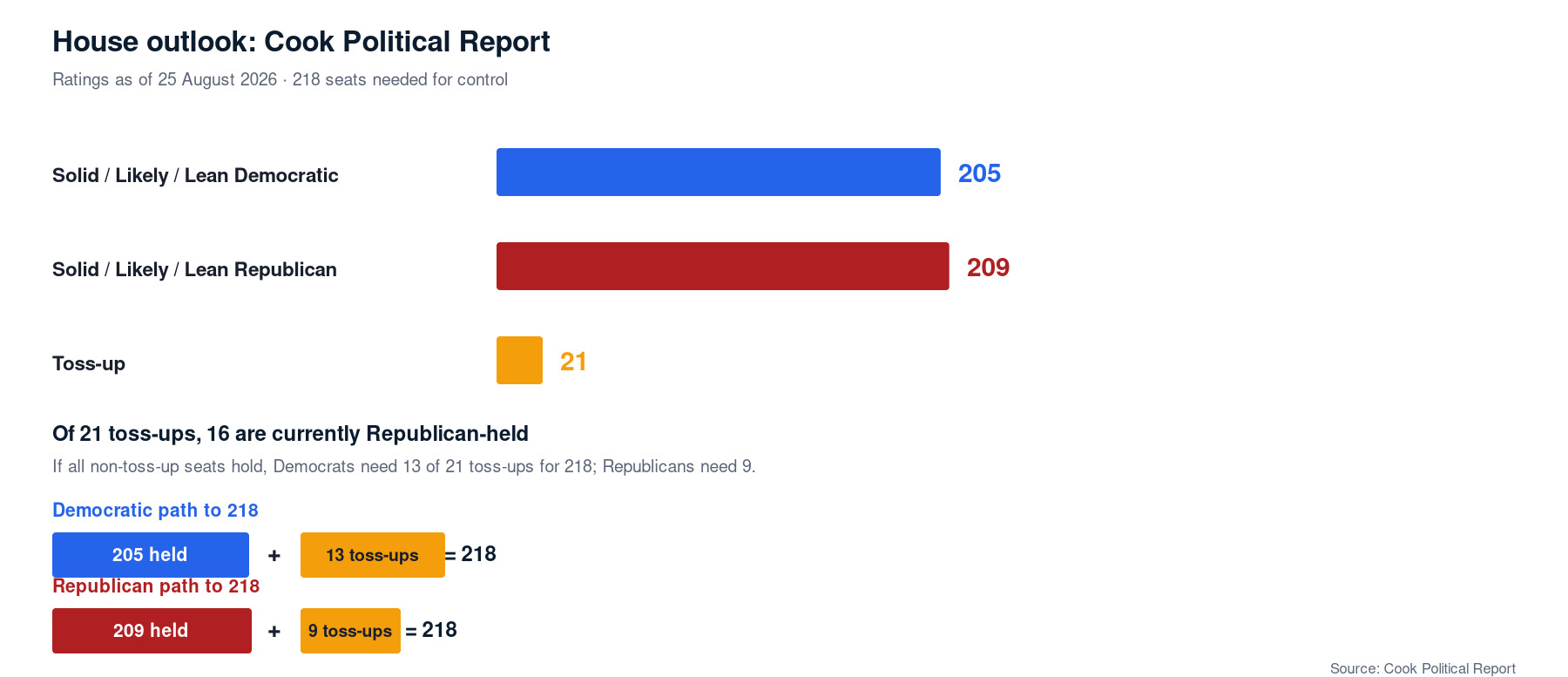
Cook Political Report, 25 August:
- 205 seats rated Democratic
- 209 seats rated Republican
- 21 toss-ups
A toss-up is a race Cook will not pick. Of those 21, 16 are currently Republican-held. If every Solid, Likely and Lean seat stayed put, Democrats would need 13 of the 21 toss-ups to reach 218. Republicans would need nine.
The 205-209 split looks close. The toss-up list is not. That is the Democratic path.
The Senate is a different race
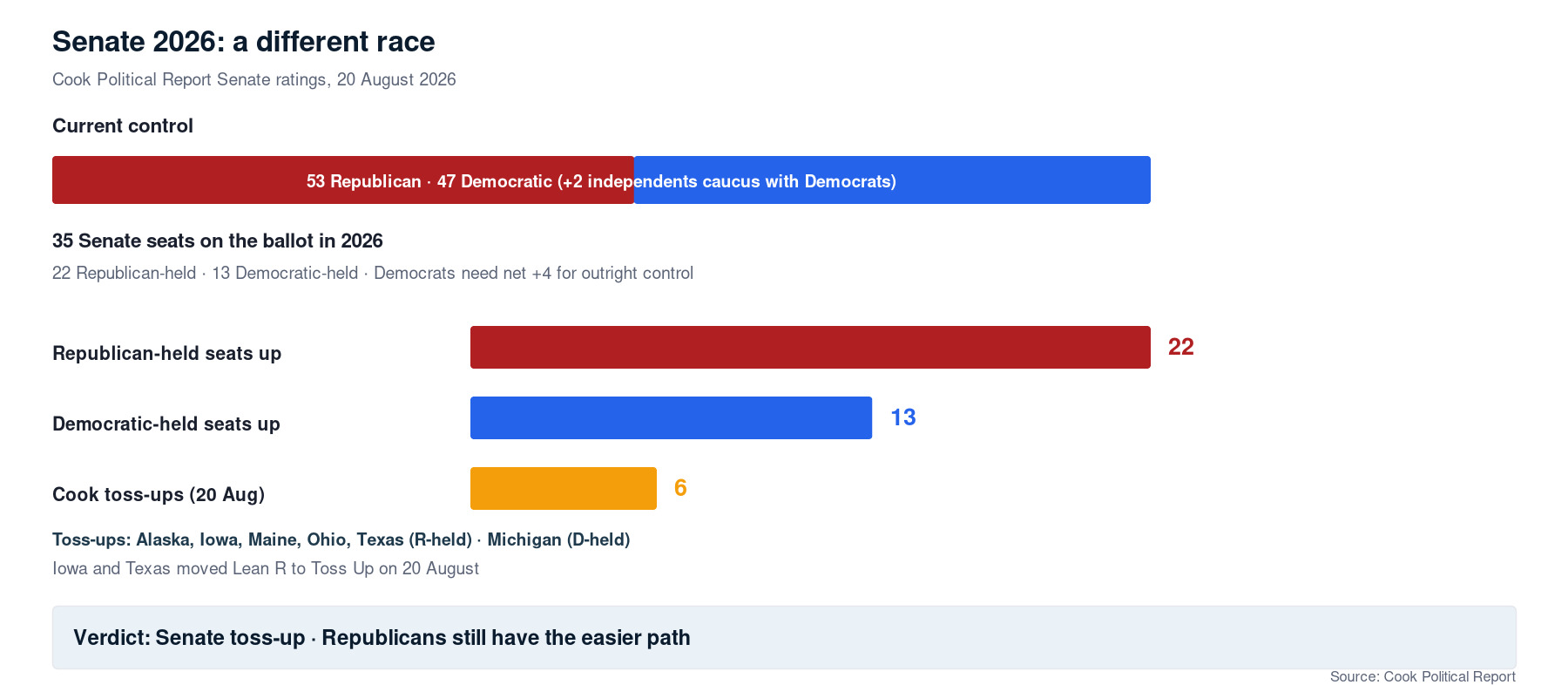
Republicans hold the Senate 53-47, counting two independents who caucus with Democrats. The vice president breaks a 50-50 tie, so Democrats need 51 for outright control-a net gain of four.
Thirty-five Senate seats are up in 2026: 33 regular Class II races and two specials. Twenty-two of those seats are Republican-held; 13 are Democratic-held. Only about a third of the Senate is on the ballot. The map matters more than the national mood.
On 20 August Cook moved Iowa and Texas from Lean Republican to Toss Up. Both states backed Trump comfortably in 2024. Cook now lists six Senate toss-ups: Alaska, Iowa, Maine, Ohio and Texas (Republican-held) and Michigan (Democratic-held).
That widens the theoretical path to four gains. It does not make those gains likely. Republicans start ahead and only need to block enough of those pickups. Cook still describes the map as structurally easier for Republicans.
Senate toss-up. Republicans have the easier path.
What this is not
Trump is not collapsing. His Republican base is intact. Republicans still hold both chambers today. August polling is a snapshot, not an election result.
Dismissing the numbers is also wrong. The generic ballot, the House toss-up list and the Iowa-Texas Senate moves point the same way: the environment is more favourable to Democrats than it was earlier in the cycle.
Current verdict: House favours Democrats. Senate is a toss-up. Republicans still have the easier Senate path. Not a collapse. A midterm warning.
Key numbers
| Measure | Latest figure |
|---|---|
| Trump net approval (avg.) | ~−20 |
| Approve / disapprove (avg.) | ~38% / ~58% |
| Republican approval (avg.) | ~80% |
| Generic ballot (Silver Bulletin, 26 Aug) | Democrats +6.6 |
| House Cook ratings (25 Aug) | 205 D · 209 R · 21 toss-up |
| Toss-ups, Republican-held | 16 of 21 |
| Senate control | 53-47 Republican |
| Senate seats on ballot | 35 (22 R-held · 13 D-held) |
| Senate Cook toss-ups (20 Aug) | 6 |