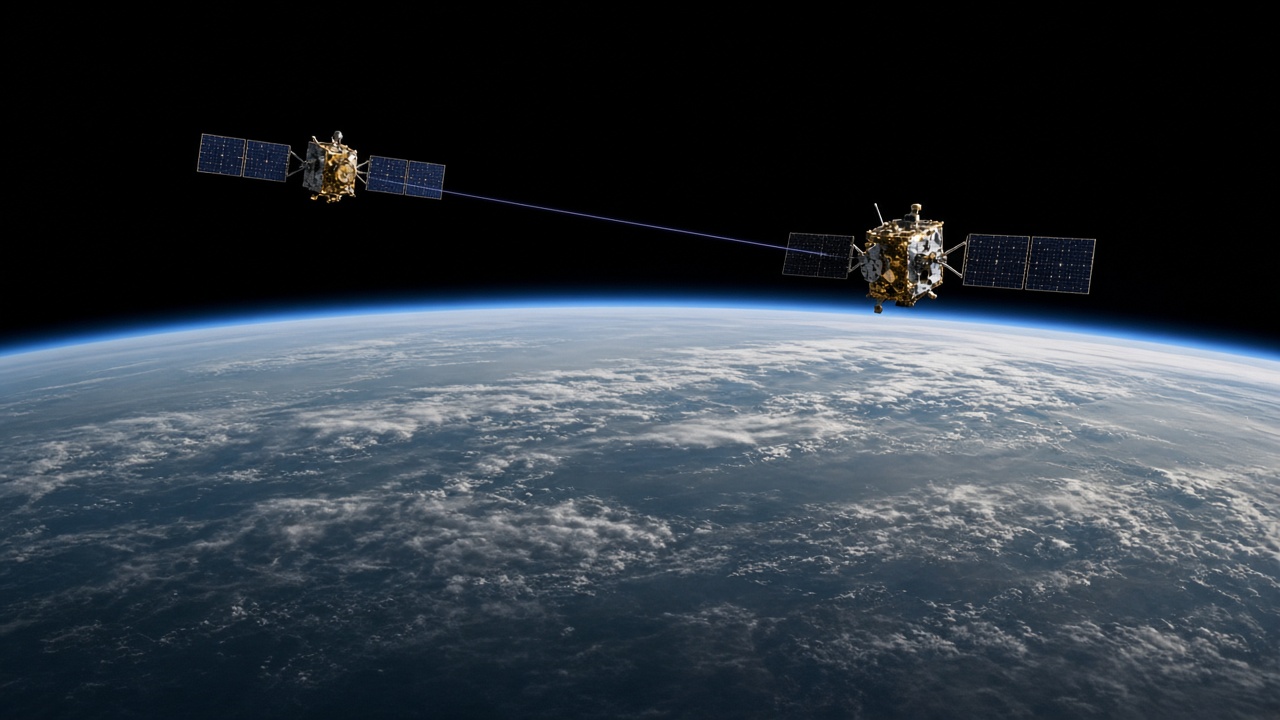
TL;DR: Star Catcher's Protostar mission collects solar energy, tracks a partner spacecraft, and laser-beams power to a cubesat on the same flight, per company and Singularity Hub reporting around 1 October 2026. CEO Andrew Rush says the space economy is power-limited; ground tests hit 1.1 kW at Kennedy Space Center in 2025. This is a first in-space demo, not a working orbital grid or guaranteed customer service.
Status note: Checked 2 October 2026 against Singularity Hub coverage dated 1 October 2026 and Star Catcher public statements cited there. Launch and in-orbit performance can slip or fail without changing the company's long-run goals. Commercial power levels and a follow-on operational satellite remain targets, not completed products in this release window.
Why power became the bottleneck above Earth
Satellites run on sunlight converted through solar panels, but orbits shade hardware, panels age, and power-hungry sensors and processors multiply with every new space service. Star Catcher's pitch is that many missions stall not because launch is impossible, but because they cannot draw enough steady watts to do useful work.
Chief executive Andrew Rush has argued the space economy is fundamentally limited by power. His company's answer is to treat energy like a beamable service: one spacecraft gathers sunlight, locks onto a client satellite, and sends converted laser light that the client's existing panels can turn back into electricity.
That idea sits between science fiction and today's constellations. Investors have signed letters of intent, yet no operator runs a paid orbital power line at scale. Protostar exists to prove the chain works outside a lab.
What Protostar is trying to prove in flight
According to Singularity Hub reporting on 1 October 2026, Star Catcher launched the Protostar prototype to test the full system in space: collect solar energy, track a target satellite, and laser-beam power to a cubesat flying on the same mission. The architecture mirrors how a future service satellite might feed a customer craft without dragging a giant panel array on every small bus.
The company claims its wavelength conversion approach can deliver up to ten times the effective power compared with standard sunlight on existing solar panels, a figure that matters only if tracking, heat management, and conversion losses cooperate in orbit. Rush has described the demo as moving closer to an orbital power grid, language that signals ambition rather than a finished utility.
Star Catcher also plans a follow-on satellite aimed at operational power levels, separate from this prototype pass. That timeline separates "we linked two boxes in space" from "we sell megawatts to a defense or telecom customer."
Ground work before the launch button
Before Protostar left the pad, Star Catcher reported a ground demonstration in 2025 that delivered 1.1 kilowatts to solar panels at NASA's Kennedy Space Center. Ground tests validate optics, software, and safety interlocks where engineers can walk up to the hardware. They do not prove the same margins against vibration, thermal cycling, and micrometeoroid risk at altitude.
The company also exercised tracking software in space later in 2025, according to the same reporting chain, splitting the problem into "can we point accurately?" and "can we deliver usable power while pointed?" Protostar combines those threads on one mission stack.
Florida's space coast ecosystem gives startups access to launch brokers and test ranges, but it does not remove physics. Laser power beaming must respect eye-safety rules, avoid blinding other spacecraft, and survive months or years of radiation.
Commercial interest versus lab caution
Star Catcher says it holds ten power purchase agreements and more than forty letters of intent from prospective customers, numbers that show marketing traction even when flight heritage is thin. PPAs and LOIs are not revenue until a satellite delivers contracted watts on schedule.
Independent researchers have welcomed the experiment while flagging limits. Max Planck scientist Hanieh Fattahi, quoted in the same coverage, noted the demo remains far below the power levels of large commercial satellites and that tracking accuracy, heat dissipation, and hardware longevity still pose hard engineering problems.
Her caution is useful context for readers who see "ten times sunlight" headlines and assume tomorrow's spy satellites will plug into a socket in the sky. Even a successful Protostar pass would leave scale, regulation, and insurance questions open.
Where things stand
On the public record around 1 October 2026, Star Catcher launched the Protostar prototype to conduct a first in-space, end-to-end test of collecting solar energy, tracking a partner spacecraft, and beaming laser power to a cubesat on the same mission. Ground tests in 2025 reached 1.1 kW at Kennedy Space Center, with separate space tracking tests later that year. Rush frames the work as easing the power bottleneck for the space economy and advancing toward an orbital grid, while Fattahi and other specialists stress that commercial-scale wattage and long-life reliability remain unsettled.
What this launch is not: a deployed orbital power grid, a guaranteed service date for LOI signers, or proof that every future satellite can drop half its panel area. It is a prototype flight meant to show the beam can close the loop in orbit. Follow-on hardware and customer contracts will write the business case if the demo holds.
Sources: Singularity Hub on Star Catcher's Protostar mission, 1 October 2026.