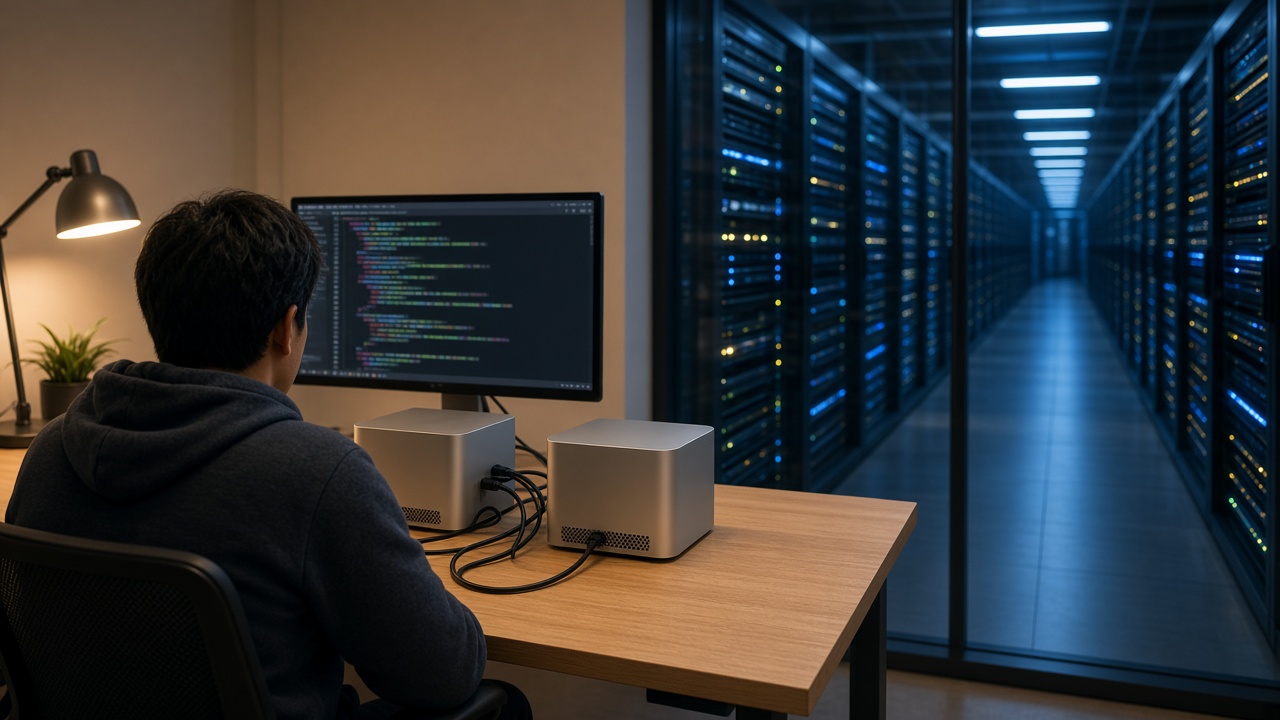
TL;DR: Apple and Meta are helping developers run Muse Spark Open locally on two to four high-end Mac Studios. That is real on-device muscle for people who can buy the kit. It is not proof that public AI is leaving the cloud. Meta's Muse for everyday users runs on a dedicated secure VM in Meta's cloud. Apple keeps a hybrid model: on-device first, Private Cloud Compute when the phone or Mac is not enough. Datacentres are not becoming "corporates only."
Status note: Checked 28 October 2026 against Meta's Muse and Muse Spark Open materials, Nvidia's 26 October Muse partnership and $3 billion Meta equity note, AMD's 27 October $1 billion note, CNBC on the 15 October Apple-Meta Mac Studio work, Apple's Siri AI / Private Cloud Compute materials, and Meta's 26 October equity-offering release. Fundraising sizes and Mac Studio list prices can still move with filings and product pages.
What Apple and Meta actually announced
On 15 October 2026, Meta released Muse Spark Open, an open-weight model with 816 billion total parameters and 42 billion active, and worked with Apple so it can run on desk hardware. Meta's docs and Apple's MLX research say the practical setup is two M5 Ultra Mac Studios with 512GB of unified memory each, or four with 256GB each, linked over Thunderbolt 5. The pitch was privacy and cost: the model runs on the desk, not in a rented public chat queue.
That hardware is not a normal laptop. CNBC put one required Mac Studio, M5 Ultra with 256GB, at least $10,799. Engadget put a four-machine 256GB stack near $38,000. Meta AI chief Alexandr Wang told CNBC that many open-weight models are too big for typical personal computers, and that Mac Studio memory makes Muse Spark Open practical. Zuckerberg posted that the model "runs great" on the new Studios after work with Apple. None of that is a speech that ordinary home PCs replace the cloud for the general public.
Muse for the public still needs a cloud computer
Meta's consumer Muse, introduced in September 2026, is built as a personal agent that does work across apps. Meta's own launch note is blunt about where it lives: Muse runs on Muse Secure VM, "a dedicated computer in the cloud," with its own browser and storage for connected services. A Sentinel agent on that machine gates what reaches the internet. Credentials sit in secure storage. People choose which apps Muse can touch.
So the mass-market Muse experience Meta is selling is not "download the agent onto your phone and cut the datacentre." It is "you get your own sealed computer, and that computer is still in Meta's cloud." Meta has talked about a later Confidential VM that even Meta cannot read. That would harden privacy. It would not move the machine onto your kitchen table. AMD's 27 October note also said EPYC processors power the dedicated computing environments behind Muse. That is datacentre silicon under the personal agent brand.
Apple's hybrid, not Apple's exit from servers
Apple Intelligence is designed to run many tasks on device. For harder requests, Apple uses Private Cloud Compute: larger server models, with Apple saying personal data is not stored and is processed only to fulfil the request. Apple's September 2026 Siri AI materials describe that hybrid architecture again.
So Apple is pushing personal and on-device AI hard. It is also keeping a cloud path for the jobs that do not fit in silicon and battery. That is a split workload, not an end-of-datacentre speech.
The money still points at racks
This week undercuts the "era is ending" frame from another angle. Meta on 26 October launched equity offerings as part of a plan that can reach about $95 billion for AI infrastructure, with roughly $35 billion in underwritten sales and a planned $60 billion at-the-market programme. Nvidia said it will invest $3 billion in that offering and deepen Muse work, with Meta expanding Vera Rubin and Vera CPU deployment plus networking gear. AMD said it will invest $1 billion. Meta had said Nvidia, AMD and Broadcom were interested in buying up to $5 billion of shares.
Chipmakers writing equity cheques into a customer that is also buying more of their datacentre kit is the opposite of a shutdown notice for AI halls.
Where things stand
Two tracks are real. One: more AI inference can sit on phones, Macs and stacked Studios for people who have the hardware, and open weights make that path wider. Two: consumer agents and hard Apple Intelligence jobs still lean on cloud computers, while Meta and peers keep building training and agent infrastructure at scale.
"Datacentre era ending; racks only for corporates" is the overstated version online. The accurate line is that personal AI is splitting. Local for some work. Cloud VMs and Private Cloud Compute for a lot of the rest. Datacentres stay in the middle of both stories.
Sources: Meta on Muse and Muse Secure VM; Meta on Muse Spark Open; Nvidia on Muse partnership and $3 billion Meta investment; AMD on Meta partnership and $1 billion investment; CNBC on Apple-Meta Mac Studio Muse Spark Open, 15 October 2026; Apple on Siri AI and Private Cloud Compute; CNBC on Nvidia and AMD Meta investments.