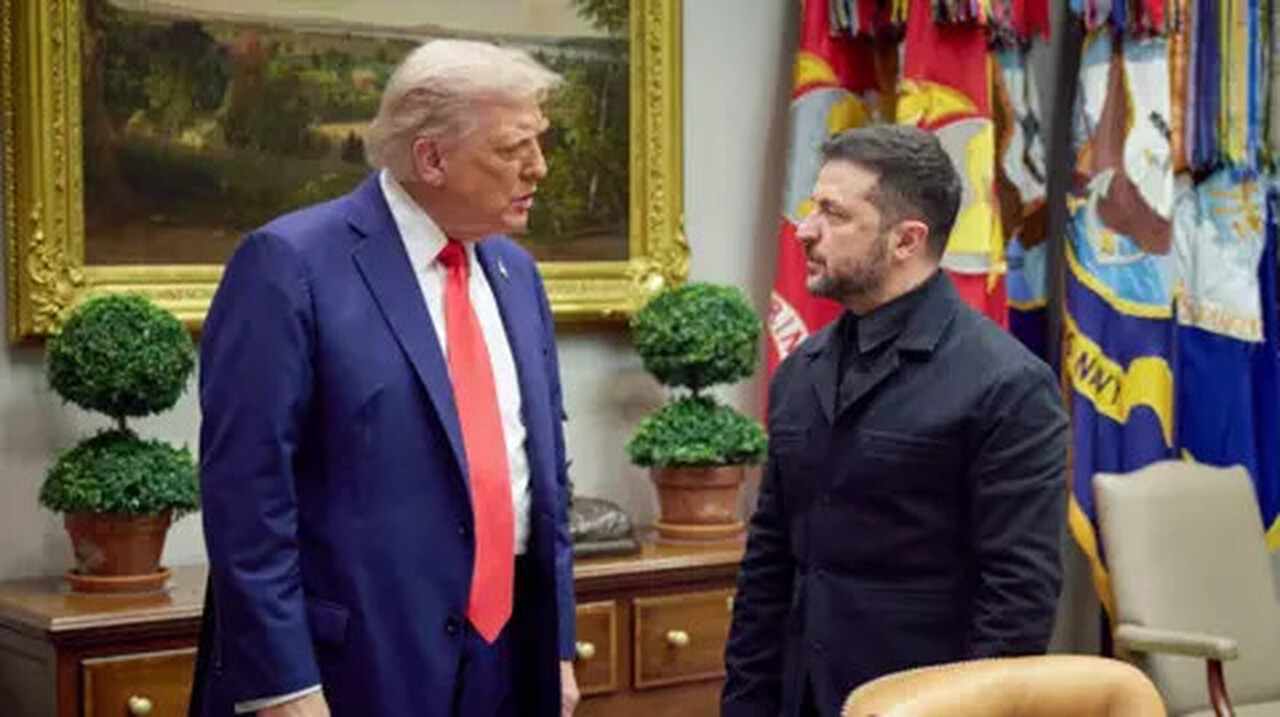
Volodymyr Zelenskyy and Donald Trump spent about 40 minutes together on 22 September 2026, on the sidelines of the UN General Assembly in New York. After the meeting, Zelenskyy said they had talked about how to end the war, and about an energy ceasefire.
He also said Ukraine is ready for that ceasefire if Russia stops attacking Ukraine's electricity, heating and water systems. Under that bargain, Kyiv would stop hitting Russian diesel and refinery targets.
That is as far as the public record goes.
Russia has not locked in the same terms. Strikes around energy infrastructure continued through the week of the meetings. Calling this a signed energy peace is false.
Status note: Checked 24 September 2026. Zelenskyy's readiness is on the record from his post-meeting press conference and later comments. Moscow's acceptance is not. This article treats the energy truce as proposed and discussed, not as a ceasefire in force.
What Zelenskyy actually said
Speaking after the Trump meeting, Zelenskyy said Ukraine was ready for an energy ceasefire if Russia did not attack "our energy system, our electricity, heating, and water supply." Ukrainska Pravda quoted him saying he was not sure Russia was ready "as of today," and that he did not know the Russian position.
He thanked Washington for agreeing to pass the proposal to Moscow. Anadolu Agency reported that he named Steve Witkoff and Jared Kushner as the US channel, and that Secretary of State Marco Rubio was due to see Sergey Lavrov in New York the next day. Those are diplomatic routes. They are not signatures.
Zelenskyy was also clear about what Trump did not ask. He said the US president did not demand that Ukraine halt strikes on Russian energy sites on its own. The offer on the table, in Kyiv's telling, is reciprocal: Russia stops hitting Ukrainian power, heat and water; Ukraine stops hitting Russian refineries and related energy sites.
That distinction matters. A unilateral halt would have been a different story. It would have asked Ukraine to stand down while Russian missiles and drones kept coming. Zelenskyy says that is not what was asked.
A meeting is not a ceasefire
Trump told reporters he had spoken with Zelenskyy about finding a way to end the war. In his UN speech he said a settlement would come "more quickly than people understand." That is a prediction. It is not evidence that Moscow has agreed to spare Ukrainian substations this winter.
Reuters, CNBC and Al Jazeera all reported the same core facts: a short UNGA sideline meeting, an energy-ceasefire discussion, Ukrainian readiness on reciprocal terms, and no completed bargain with Russia.
CNBC also reported Zelenskyy asking Trump to organise a trilateral meeting with Vladimir Putin, and to engage China's Xi Jinping. Those are further asks. They sit beside the energy proposal. They do not complete it.
Why energy is the winter lever
Ukraine has spent successive winters repairing and defending the grid. Russia has spent those winters trying to knock out generation, transmission, heat and water. The aim is not only military. It is to make cities dark and cold, to force outages, and to raise the political cost of continuing the war.
Ukraine has answered in kind on a narrower target set: Russian oil refining and related fuel infrastructure. Those strikes do not turn off the lights in Moscow in the same way a hit on a Ukrainian thermal plant turns off the lights in Kharkiv. They do hit diesel, export revenue and logistics.
An energy truce would freeze both of those campaigns, if both sides kept it. That is why Zelenskyy tied electricity, heating and water to any promise to leave Russian refineries alone. He is not offering a gesture. He is offering a swap of winter pressure.
A deal that only stops Ukrainian strikes, while Russian missiles keep flying at the grid, would not be an energy truce. It would be a pause on one side.
What is not proven
It is reasonable to say winter energy targets are leverage. It is not proven, on the public record of this meeting, that US midterm fuel prices are the reason Trump discussed the idea.
Politicians in Washington care about petrol and heating-oil headlines. Ukraine cares about keeping the lights on. Russia cares about refinery outages and about keeping Ukraine miserable through the cold months. All of those incentives can sit in the same room. None of them was documented in Zelenskyy's account as the official US motive.
This site will not put a midterms-price theory on screen as established fact. If a principal says that, quote them. If an analyst argues it, label it as analysis.
It is also not proven that Russia will refuse forever, or accept tomorrow. Zelenskyy left the Russian position open. That is the honest version.
Strikes did not wait for the communique
Reporting around the UN meeting said energy strikes continued. That is what you would expect if no halt is in force. A ceasefire that exists only in a press conference does not move air-defence crews or missile batteries.
Watch three things from here.
First, whether Moscow gives a public yes, a public no, or a condition that guts the swap (for example, demanding Ukraine stop all long-range strikes while Russia keeps a free hand against the grid).
Second, whether Witkoff, Kushner or Rubio come back with a Russian counter-offer that Kyiv can live with. A channel is not a result.
Third, whether the strike pattern on Ukrainian power, heat and water, and on Russian refining, actually changes. That is the only verification that counts.
What can be said cleanly
The short version is also the accurate one.
Ukraine told the United States it will stop hitting Russian energy sites if Russia stops hitting Ukrainian electricity, heating and water. Trump heard that in New York. He did not, according to Zelenskyy, demand a one-sided Ukrainian halt. Russia has not accepted the bargain. The war's energy track is still live.
Anything stronger than that is ahead of the evidence.
Sources: Reuters, 22 September 2026; Ukrainska Pravda; Anadolu Agency; CNBC, 23 September 2026; The Guardian briefing, 23 September 2026.