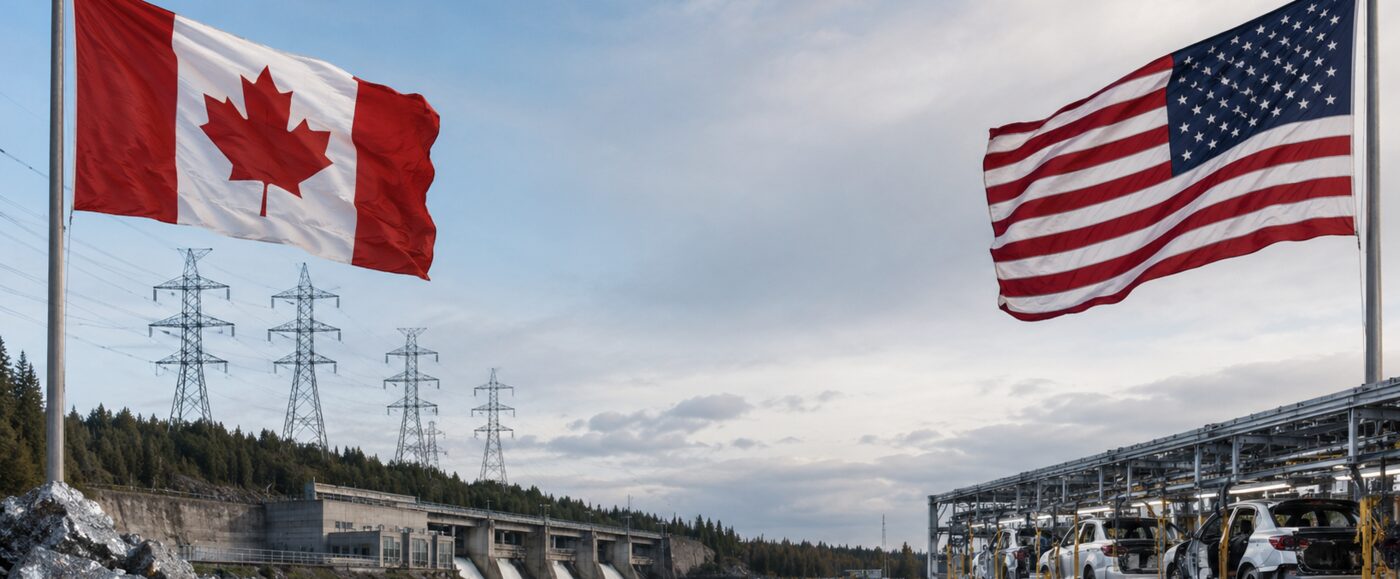
Donald Trump’s latest threat against Canada is not simply another increase in a tariff schedule.
The U.S. president says he will impose 50% tariffs on Canadian-made cars, trucks and auto parts from January 1, 2027, after the latest trade negotiations between Washington and Ottawa collapsed. If implemented as described, the measure would strike one of the most deeply integrated industrial supply chains in North America.
But the date matters. These automotive tariffs have been threatened; they are not currently in force.
That distinction can easily disappear in a fast-moving trade story. The United States has already activated a separate package of 50% tariffs covering roughly US$20 billion of Canadian exports. Canada says it will answer those duties dollar for dollar from September 8. The additional 50% vehicle measure is a future threat layered on top of that existing dispute. Reuters reported the automotive threat on August 24, while its August 22 report details Canada’s planned retaliation.
The argument is now expanding beyond tariffs. Canadian political leaders have raised electricity and critical minerals as possible sources of leverage over the United States. No export cutoff has been announced. But the fact that these options are being discussed shows how quickly a dispute over trade rules can spread into energy security and strategic supply chains.
What is actually happening?
The easiest way to understand the confrontation is to separate four different policy stages.
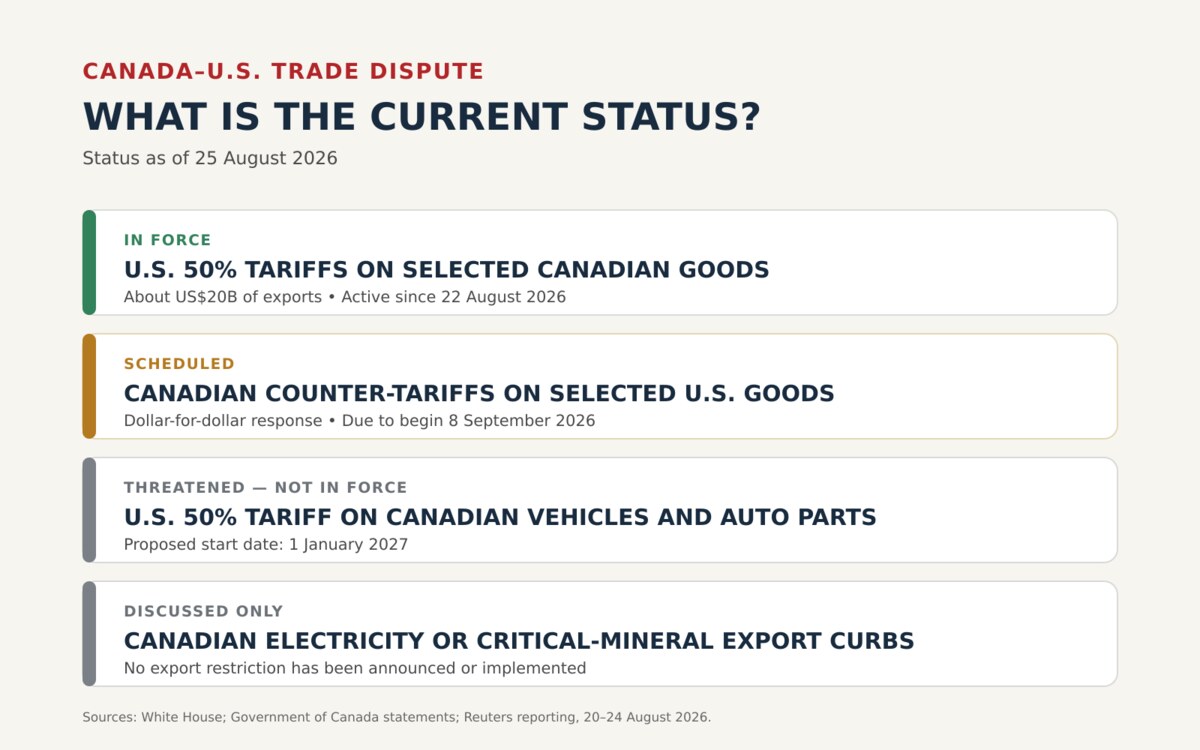
The existing U.S. duties cover products including wine, furniture, dairy goods, cement, clothing, fishing rods and hockey equipment. They affect around 5% of Canada’s exports to the United States and, unusually, do not preserve the normal USMCA exemption for qualifying goods. Energy, potash and critical minerals were exempted from that particular package. Reuters described the scope and exemptions.
Prime Minister Mark Carney says Canada’s September response will cover U.S. products including steel, dairy, appliances, agricultural equipment, pulp and paper, and electronics. The detailed list still matters: a promise to retaliate dollar for dollar does not reveal which individual companies, regions or consumers will bear the greatest cost.
Why the automotive threat is different
Cars do not move across the Canada-U.S. border as simple finished products.
North American vehicle production functions as an integrated manufacturing system. Engines, transmissions, electronics, steel and other components can cross the border several times before a completed vehicle reaches a dealer. Ford chief executive Jim Farley described Canada, Mexico and the United States as an integrated manufacturing system during the 2026 USMCA debate. Reuters reported his comments in January.
A broad 50% duty could therefore affect more than Canadian assembly plants. It could raise input costs for U.S. factories, disrupt production planning, alter sourcing decisions and eventually increase vehicle prices. The exact impact would depend on the legal instrument, rules for U.S. content, possible exemptions and whether the threat ever takes effect.
This is also why the January start date should be treated as political and commercial pressure - not as a settled outcome. It gives both governments and the automotive industry time to negotiate, lobby for exclusions or challenge the measure.
Canada has leverage - but it is not evenly distributed
Canada’s largest weakness is obvious: its economy remains heavily tied to the American market. The U.S. share of Canadian merchandise exports fell from 75.9% in 2024 to 71.7% in 2025, but it still dwarfs every other destination. Statistics Canada published the annual comparison.
That dependence means a broad trade war would usually impose greater economy-wide pressure on Canada than on the much larger United States.
Yet aggregate size is not the whole story. Canada can matter disproportionately in particular sectors, states and supply chains. Electricity flowing into neighbouring U.S. power markets and minerals used in agriculture, defence, energy and manufacturing are two of the clearest examples.
The leverage is therefore concentrated rather than universal. It can create political pressure in affected regions without giving Ottawa a painless way to force Washington to change course.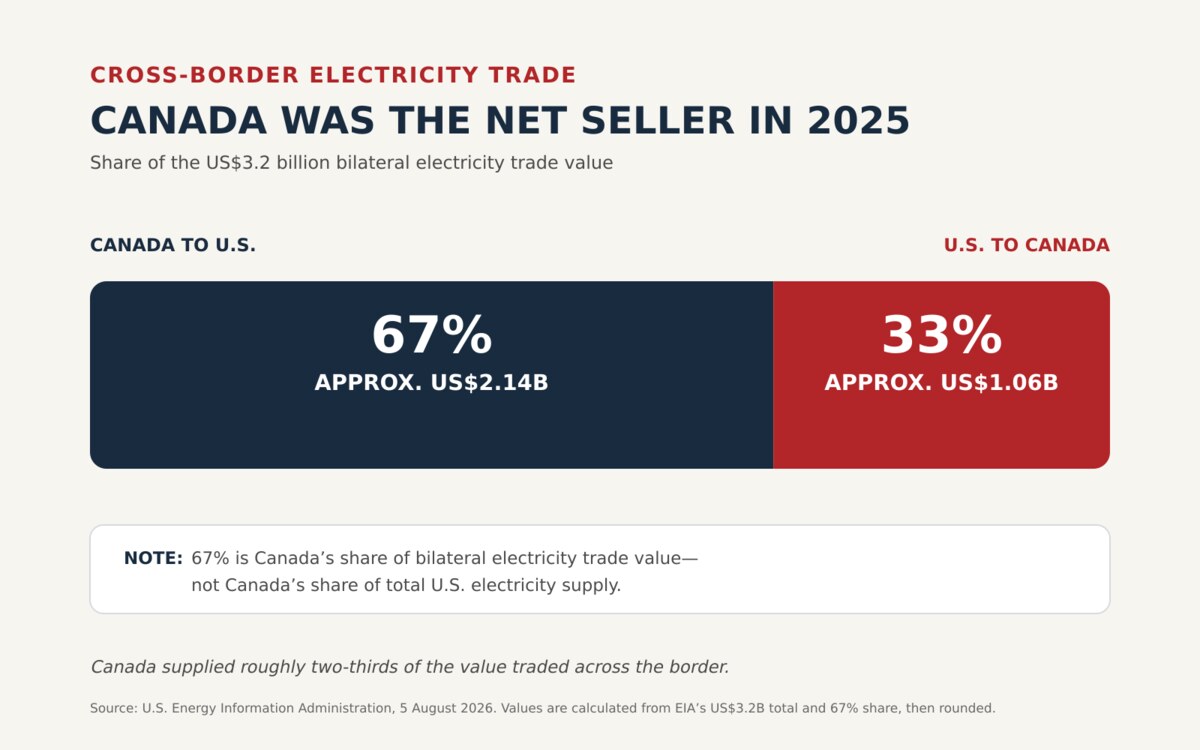
Electricity is regional leverage, not a national off switch
Canada and the United States exchange electricity in both directions through an interconnected grid. In 2025, the combined value of bilateral electricity trade was about US$3.2 billion. Electricity imported by the United States from Canada represented 67% of that value, while U.S. exports to Canada represented 33%, according to the U.S. Energy Information Administration. That equates to approximately US$2.14 billion flowing south and US$1.06 billion flowing north by trade value. EIA’s 2025 bilateral energy analysis provides the underlying shares.
Those numbers show an imbalance, but they do not mean Canada supplies 67% of American electricity. The percentage describes the value of cross-border electricity trade, not the share of total U.S. power consumption.
The exposure is concentrated in connected states and provinces. Ontario, Quebec, Manitoba and British Columbia trade with neighbouring U.S. markets. During the earlier 2025 tariff confrontation, Ontario imposed a 25% surcharge on electricity exports to New York, Michigan and Minnesota, then suspended it during negotiations. That episode demonstrated that electricity can be used as pressure - but also that it can trigger rapid escalation. Reuters covered the Ontario surcharge.
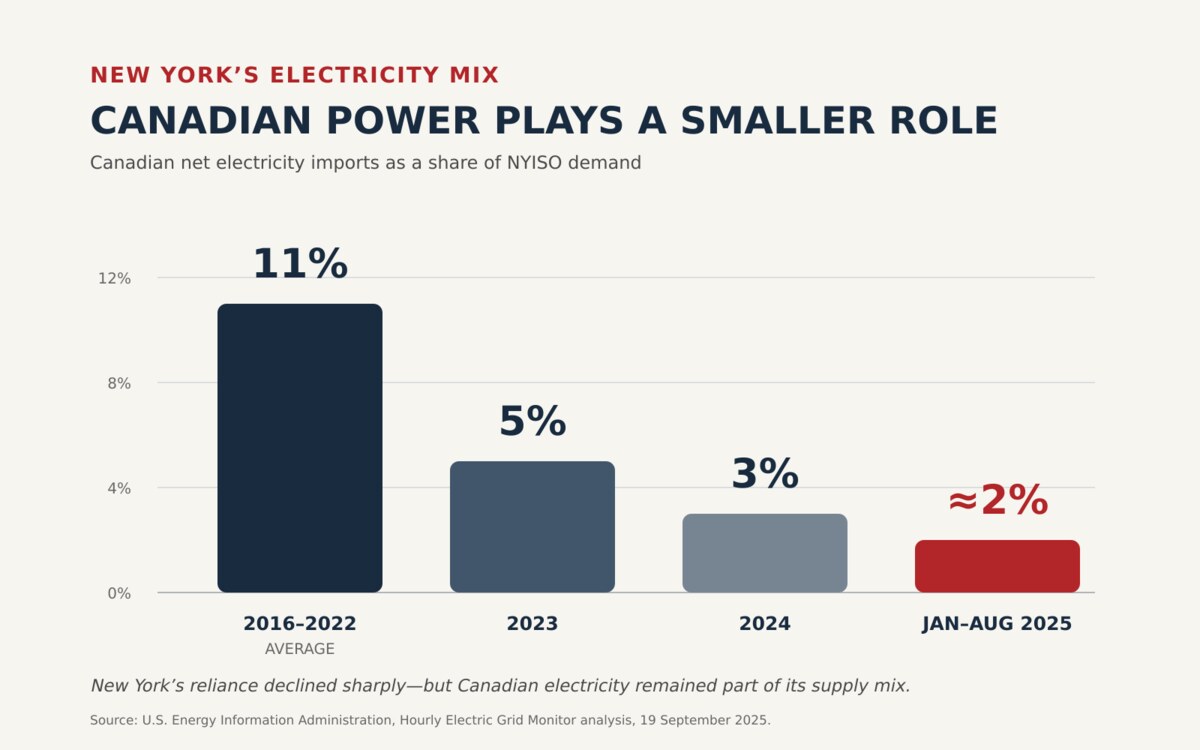
American reliance has also been changing. Canadian imports supplied an average 11% of demand in New York’s grid region from 2016 to 2022, according to EIA, before falling to 5% in 2023, 3% in 2024 and roughly 2% through August 2025. EIA’s regional analysis shows why historical dependence should not be presented as today’s exposure.
Restricting exports could still tighten supply or raise prices in particular markets at particular times. But Canada would also give up export revenue and potentially complicate grid reliability and long-term commercial relationships. Electricity is a bargaining tool, not a cost-free weapon.
Critical minerals create a different kind of pressure
Minerals matter because replacing a supplier can require new mines, processing plants, transport routes, contracts and regulatory approvals. These cannot always be created quickly.
Canada’s mineral exports are substantial and heavily connected to the United States. Natural Resources Canada reported that the U.S. received 52% - about C$80 billion - of Canadian mineral exports in its latest sector snapshot. The same federal data show that critical-mineral exports are concentrated in a handful of products: aluminium accounts for 55%, followed by potash at 18%, nickel at 9%, uranium at 6% and zinc at 4%. Together, these five represented 92% of Canada’s critical-mineral exports. Natural Resources Canada’s mineral trade data and its sector factsheet provide the source figures.
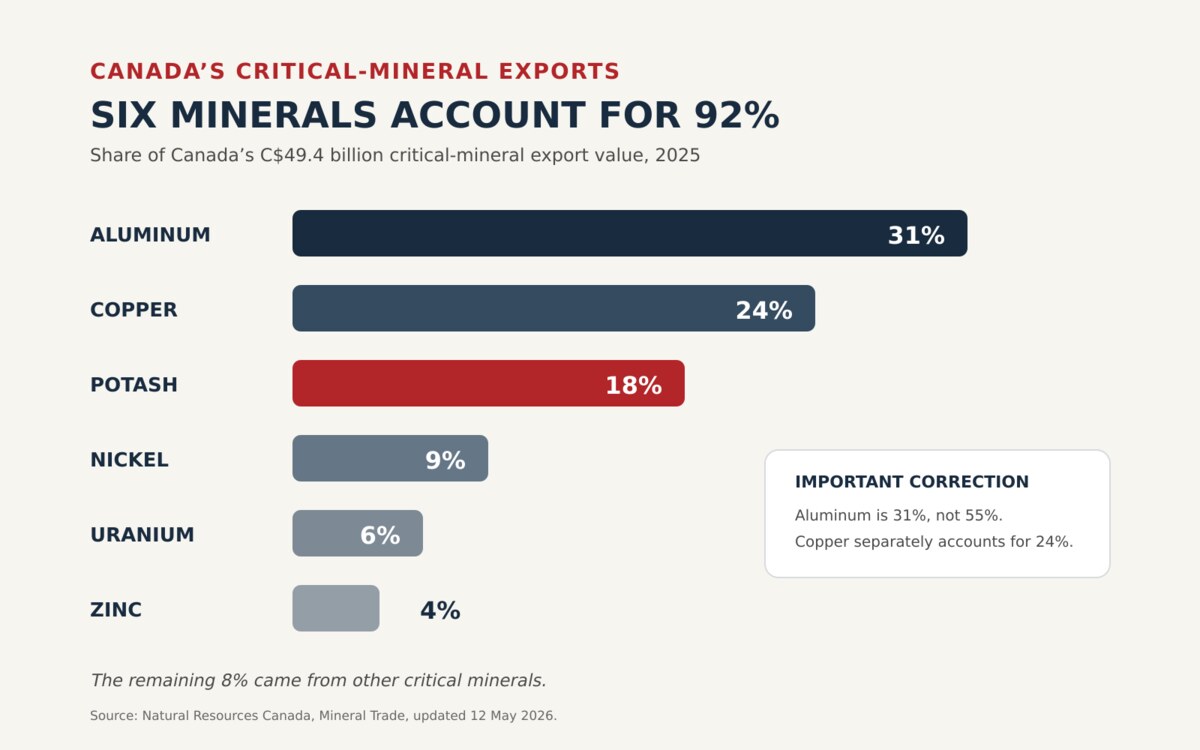
This is not the same as saying the United States obtains those exact percentages of each mineral from Canada. The table shows the composition of Canadian critical-mineral exports by value. A separate U.S. import-dependence chart should be built commodity by commodity from USGS data rather than mixing unlike measures.
It is also important not to imply that Ottawa can turn all mineral shipments on or off instantly. Mines and processing facilities are operated by companies; provinces have major authority over natural resources; export controls involve legal and commercial constraints; and Canadian producers depend on American customers. British Columbia Premier David Eby has proposed reducing U.S. access to critical minerals, while other provincial leaders have resisted using resource exports as leverage. This is a live political option, not a unified national policy. Reuters reported the provincial split.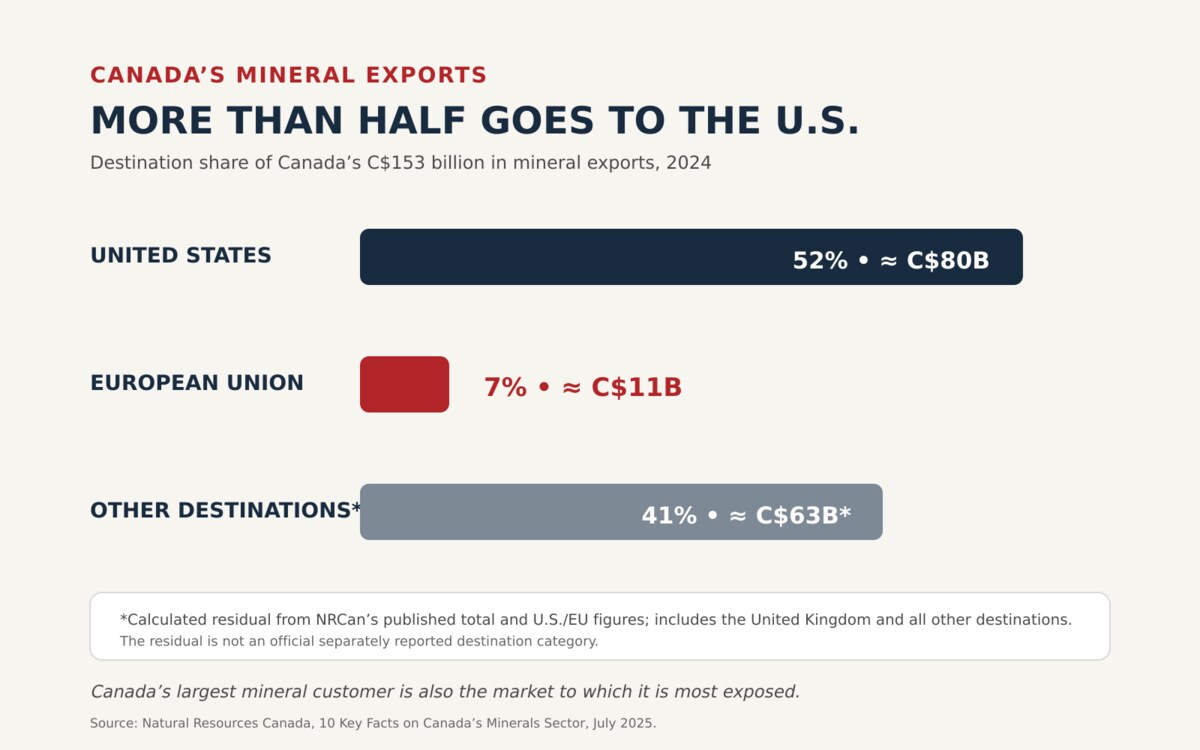
Could Canada redirect these exports elsewhere?
Diversification is possible over time, but geography and infrastructure matter.
The United Kingdom, European Union and Asian markets can absorb some Canadian products, and Canada is actively seeking deeper non-U.S. trade relationships. However, nearby American customers are often connected by existing pipelines, power lines, rail networks, roads and long-term supply contracts. Electricity is especially difficult to redirect overseas. Minerals are more tradable, but port capacity, processing requirements and buyer specifications limit how quickly flows can change.
This is why the phrase “sell it somewhere else” is not a complete near-term strategy. Canada can reduce its dependence on the United States, but replacing a market that took 71.7% of its merchandise exports in 2025 would be a multi-year economic transformation.
What would escalation mean for households and businesses?
Tariffs are charged at the border, but their costs spread through supply chains.
Canadian exporters can respond by lowering prices, accepting smaller margins, reducing production or redirecting sales. U.S. importers may absorb part of the charge or pass it to manufacturers and consumers. Canadian counter-tariffs can similarly raise costs for domestic importers and buyers.
In autos, the risks include more expensive parts, production delays, fewer model choices and higher vehicle prices. In electricity, effects would vary by region and season. In minerals, disrupted supplies could feed into fertiliser, metals, energy and manufacturing costs.
None of these outcomes is automatic. Businesses can change suppliers, governments can grant exemptions, currencies can move and demand can weaken. But the more frequently tariffs change, the harder it becomes for companies to plan investment, inventory and hiring.
The real question is how far both sides are willing to go
Canada cannot match the United States market for market. The American economy is larger, and Canada remains far more dependent on bilateral trade.
But Washington is not insulated. North American manufacturing was built around predictable cross-border trade, and particular U.S. regions and industries rely on Canadian inputs. That gives Canada pressure points - even if using them would also damage Canadian producers and consumers.
The next milestones are concrete:
-
the detailed Canadian tariff list and its scheduled September 8 implementation;
-
any formal U.S. proclamation or customs guidance for the threatened January 2027 vehicle duties;
-
possible exemptions or rules for U.S.-origin content;
-
any provincial action involving electricity, minerals or procurement;
-
renewed negotiations over autos and the future of USMCA.
Until those steps occur, the most accurate conclusion is not that Canada has cut off electricity or minerals, or that a new 50% auto tariff is already being collected.
It is that a tariff conflict once confined to selected goods is moving toward the foundations of the North American economy: vehicles, energy and strategic resources.
And once those sectors become bargaining chips, the cost of miscalculation rises on both sides of the border.