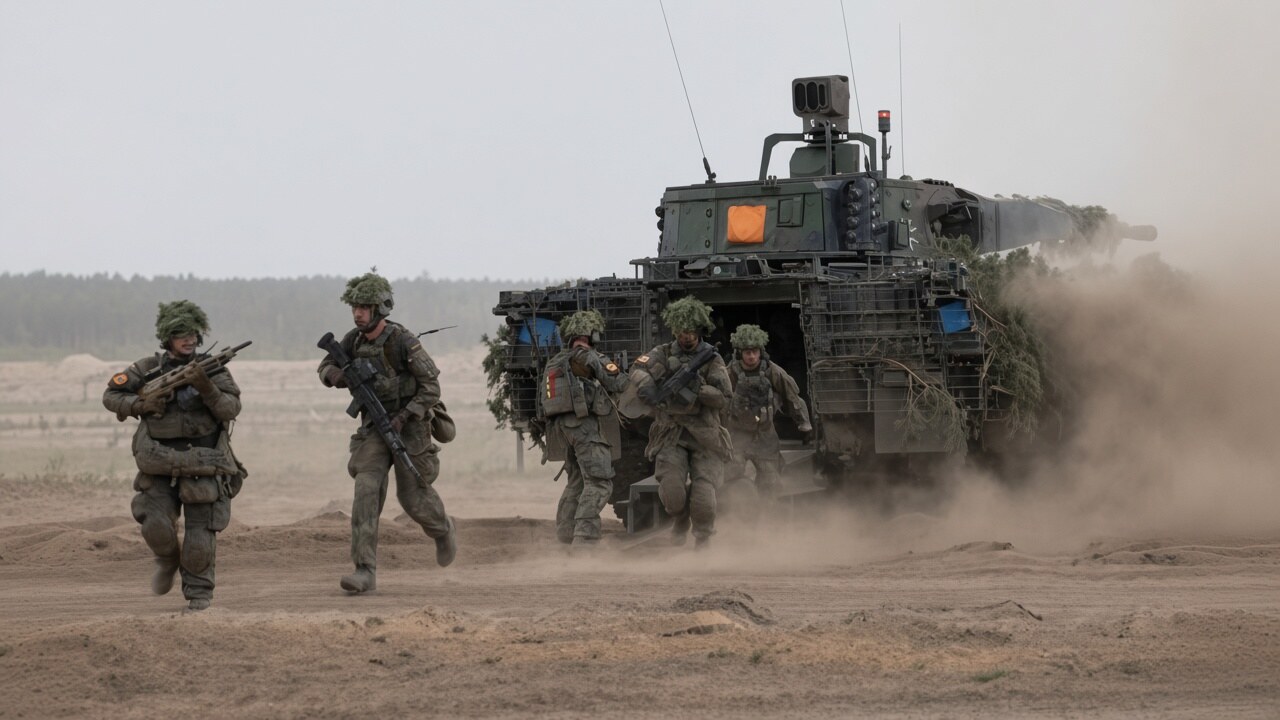
On 22 September 2026, in Tallinn, Air Chief Marshal Sir John Stringer told the Associated Press that Vladimir Putin is becoming "increasingly cavalier, dangerous and risk accepting." Stringer is NATO's Deputy Supreme Allied Commander Europe. He was speaking at a security conference in Estonia, on the alliance's eastern flank.
That quote is already being stretched into a claim the public record does not support: that Russia is about to invade NATO.
Stringer did not say that. Estonia's leadership, speaking in the same news cycle, called a conventional attack on Europe improbable while Russian forces are tied down in Ukraine and while NATO's collective defence still exists. The warning on the table is hybrid pressure. The gap between those two sentences is the point.
Status note: Checked 24 September 2026. Stringer's Estonia remarks are from his 22 September interview with AP, carried by The Independent and other outlets. This article does not claim an imminent conventional attack on NATO territory. It also does not claim Russia has given up the option of escalating covert activity.
What Stringer said, and what he did not
Stringer described a "febrile environment": drone incursions, espionage, sabotage, cyber attacks and other activity that sits below a declared war. He said NATO countries should be careful, because Putin would like to provoke an "overreaction."
He also drew a fine line between accident and intent. Some drones that enter NATO airspace, he said, may have been thrown off course by Russian GPS jamming and other electronic measures used against Ukrainian strikes. Possible, in other words, does not mean decided. Russia could escalate that kind of activity. Stringer said that does not mean Moscow has already chosen to do so.
The deputy commander's political reading is that Putin is looking for ways to split the allies because the campaign in Ukraine is going badly. Covert action that is hard to attribute is useful for that. A tank army crossing a NATO border is not. The first can be denied. The second starts Article 5.
That is why the hybrid track is the rational one if the aim is to test nerves, not to fight the alliance in the open.
Eastern-flank politics, not an invasion clock
Stringer was not talking in a vacuum. European leaders have spent late September warning about sabotage, infrastructure and other tests of NATO's collective defence. Polish and French voices have been part of that chorus. The UN General Assembly week put those ministers in the same city as the Ukraine energy talks. The subjects share a calendar week. They are not one plot.
Estonia's Kristen Michal, in the AP account, said Putin is trying to undermine the collective-defence pact with covert attacks that are hard to pin on the Kremlin. He also said a conventional military attack on Europe is currently "improbable," because of the NATO response that would follow and because Russian forces are committed in Ukraine.
Michal's other point is colder. He said the high level of malign activity is "here to stay" until Putin changes his military goals, and that the way to deter it is to keep backing Ukraine. In that telling, hybrid pressure is a consequence of Western support for Kyiv, not proof that NATO forgot how to defend itself.
Those are allied judgements. They are not Ukrainian or Russian official statements. Treat them as what they are: the people who would have to fight a conventional war saying they do not see one on the near calendar.
Why the fight stays below Article 5
Article 5 is NATO's promise that an armed attack on one ally is an attack on all. It is a high tripwire. A recognised invasion would force a choice that Moscow has good reasons to postpone while it is already in a grinding war in Ukraine.
Sabotage of a railway, a cut cable, a cyber intrusion, a drone that crosses a border and crashes in a field: each of those can be called an accident, a criminal case, or a one-off. Each burns political attention. Each invites an argument inside NATO about how hard to hit back. That argument is the prize, if the goal is division.
Stringer's warning against overreaction sits in that logic. A wild response to a murky incident can split the alliance faster than the incident itself. A timid response can invite the next test. The uncomfortable job of the eastern flank is to live between those errors.
None of this makes the hybrid activity small. Pipelines, undersea cables, airports, railways and power systems are easier to hurt than a prepared brigade. Societies feel those hits. The claim that fails is the one that turns every cable story into "war starts in October."
What would make the invasion claim real
Two things would have to show up together.
First, allied intelligence of plans for an imminent conventional attack on NATO territory, not more sabotage. Second, a force posture that matches those plans: units pulled from Ukraine or reconstituted at scale, logistics built for a new front, air and missile forces pointed at the alliance rather than at Ukrainian cities.
Those facts are not in Stringer's interview. They are not in Michal's "improbable." They are not in the late-September hybrid warnings from Warsaw or Paris, as reported.
If they appear, this article is wrong and should be pulled. Until they appear, "NATO invasion next month" is a different story from the one the deputy commander told.
How to hold both ideas at once
Putin can be more risk-tolerant and still not be about to roll tanks into Estonia. Hybrid pressure can rise because the Ukraine war is going badly, not because a second war has been scheduled. Allies can warn about cables and drones without asking the public to sleep in a shelter.
The short version matches the long one. Russia is pressing NATO below the Article 5 line. The alliance's own deputy commander wants capitals to see that pressure clearly and not take the bait of a panic. He did not announce an invasion.
Sources: The Independent / AP, 22 September 2026; The Independent follow-up; AP text via WRAL.