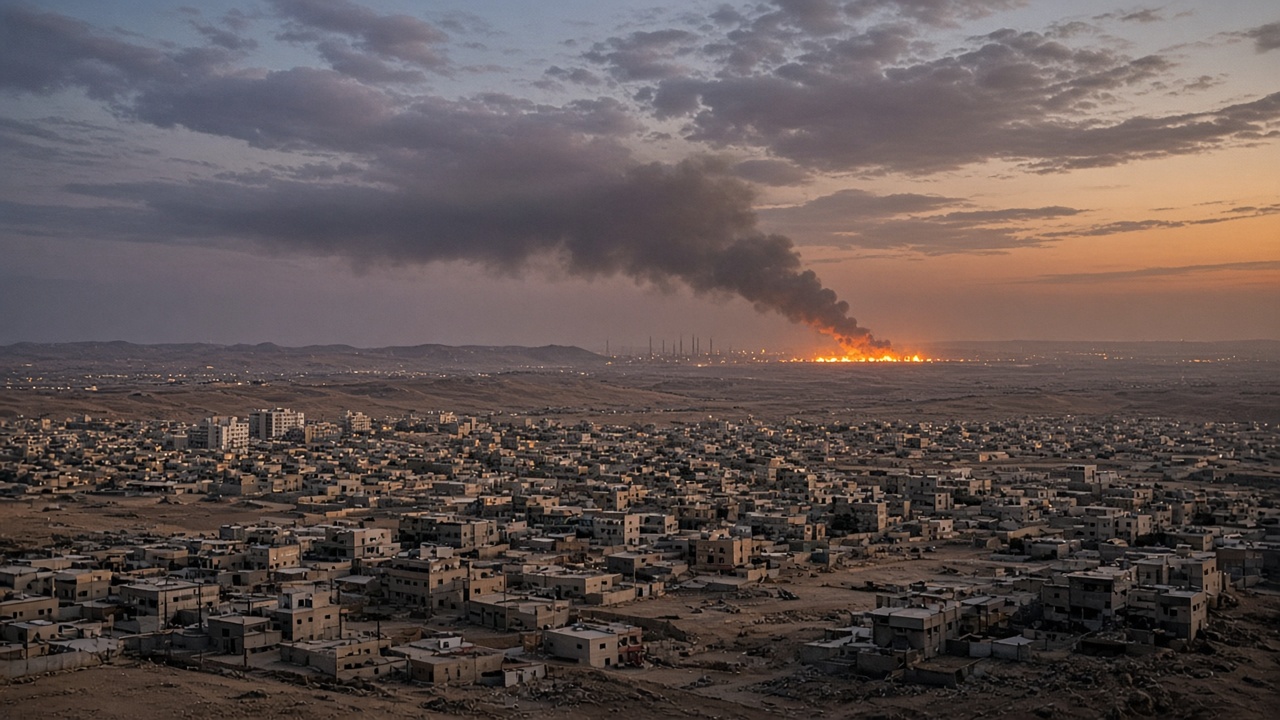
TL;DR: The Houthis said they hit a Saudi Aramco site in Riyadh on 3 to 4 October 2026 with ballistic missiles and drones, after Saudi-led strikes on Yemen. Reuters, via The Hindu, reported witnesses seeing smoke and fire near an Aramco facility in the capital on Saturday. Riyadh did not promptly confirm damage and Aramco did not comment right away. The Houthis also claimed Khurais and major fires while alleging about 50 Saudi-led strikes in 12 hours, figures AMU treats as their side's claims unless independently verified. A week earlier Saudi Arabia said it intercepted six ballistic missiles aimed at Taif and Yanbu after a separate Houthi Aramco claim. This is a rebel claim plus witness smoke, not a confirmed production loss.
Status note: Checked 5 October 2026 against Reuters reporting carried by The Hindu on 3 to 4 October 2026. Saudi confirmation, Aramco statements, and independent damage tallies can still land. Treat Houthi strike counts and fire descriptions as claims unless Riyadh or open-source verification backs them.
Why Riyadh and Aramco sit in the crosshairs again
The Iran-aligned Houthis control much of northern Yemen and have spent years firing missiles and drones at Saudi Arabia and the United Arab Emirates whenever the wider Middle East war heats up. Aramco is the state oil company that funds much of the Saudi budget, so naming Riyadh targets sends a political message even when interceptors work.
A United Nations-backed truce largely held from 2022 until this year's spillover from the Iran war pulled Yemen back into the fight. Defense News and other outlets have tracked a renewed Yemeni government offensive backed by the Saudi-led coalition, while the Houthis frame their strikes as payback for raids on Sanaa and other provinces. Readers far from the Gulf should hear that sequence: Yemen's civil war never fully ended; it reattached to the bigger Iran confrontation.
What the Houthis claimed this weekend
According to Reuters coverage summarized by The Hindu, the Houthis said ballistic missiles and drones hit an Aramco facility in Riyadh, describing the operation as retaliation for recent Saudi attacks on the Yemeni capital and elsewhere. That language matches a pattern from earlier in the week, when the group also claimed strikes toward Saudi energy infrastructure.
On the ground, Reuters quoted witness accounts of a large plume of smoke and fire near an Aramco facility in Riyadh on Saturday. Visual evidence of smoke is not the same as verified structural damage or a published outage figure. Oil markets react to both, but responsible reporting separates "something burned near an Aramco site" from "barrels offline."
Later on 4 October, Reuters also reported the Houthis claiming hits on Khurais and describing major fires, while asserting that Saudi-led forces carried out about 50 strikes in a 12-hour window. AMU attributes those numbers to Houthi statements unless independent monitoring confirms them. Saudi Arabia had not, in the immediate reporting window, matched each claim with its own damage bulletin.
The week before: Yanbu, Taif, and intercepts
The Riyadh claim did not arrive in a vacuum. The prior week the Houthis said they struck toward Yanbu, another nerve point on the Red Sea energy map. Saudi officials responded that air defenses intercepted six ballistic missiles heading for Taif and Yanbu and reported no Aramco damage at that time.
That earlier exchange matters for reading the weekend news. It shows Riyadh is willing to confirm intercepts quickly when it chooses to speak, which makes the silence or delay after the Riyadh plume part of the story. Either officials were still assessing, or they decided not to validate the Houthis' narrative. Neither outcome proves the strike failed, and neither proves a catastrophic hit.
Where things stand
As of early October 2026 the confirmed public record is asymmetric: a Houthi claim of a Riyadh Aramco strike, witness reports of smoke and fire, and no immediate Saudi or Aramco confirmation in the Reuters chain The Hindu published. Social posts that treat rebel media as proof of a crippling outage jump ahead of the evidence.
Energy traders and Gulf residents should watch for Saudi statements, satellite imagery, and any Aramco operational update. Until then, treat this as a serious claim with visual corroboration near an industrial site, not as a settled count of lost barrels or a formal acknowledgment from the kingdom.
Sources: The Hindu, carrying Reuters on Houthi Aramco claims, 3 to 4 October 2026.