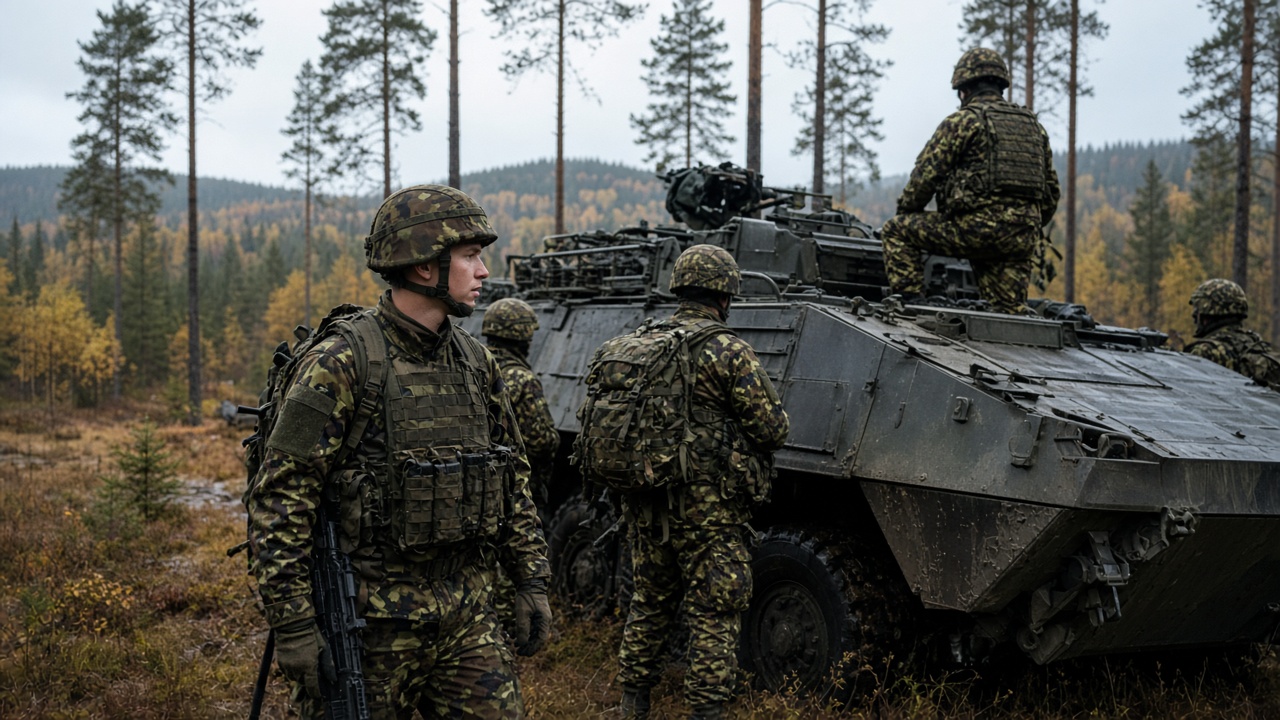
TL;DR: ERR's FT summary says Estonia's 1st Infantry Brigade is relocating permanently from Tapa, about 130 km from the Russian border, to Jõhvi, about 50 km away. Col. Tarmo Kundla said the force must "start from the border and win from the first battles." A Narva base will hold up to 1,000 troops (200 permanent, 800 in a crisis). Active defence entered national policy in May. Estonia is buying nine HIMARS with M57 missiles up to 300 km and nine South Korean Chunmoo launchers with similar range. Defence spending is up 42% this year to €2.4 billion, or 5.4% of GDP. The UK contingent rises from 800 to 1,200 by April next year. Intel: no full-scale NATO war expected in the next two years, but a critical Baltic window of one to four years, with Narva as a limited-probe worry.
Status note: Checked 6 October 2026 against ERR's 5 October 2026 summary of Financial Times reporting on Estonian defence officials. Brigade moves, base timelines, and allied troop numbers can still change. This is Estonia's announced posture, not confirmation of an imminent Russian attack or a NATO Article 5 case.
Why Estonia is rewriting the old plan
For years after Russia's 2014 seizure of Crimea, Estonian planners assumed a fast guerrilla-style defence: use forests and swamps, bleed an invader, and hold until NATO reinforcements arrived. Watching Russia's war in Ukraine changed that math. Officials told the FT that Moscow accepts heavy losses and then holds ruined ground rather than trading it away. For a country of about 1.3 million people and 45,000 square kilometres, trading space looks fatal.
Active defence became national policy in May. The aim, in the defence minister's public line as the FT recounted it, is to make aggression unthinkable and keep the fight and destruction off Estonian soil. Col. Tarmo Kundla, commander of the 1st Infantry Brigade, put the operational version simply: start at the border and win the first battles.
Tapa to Jõhvi, and a bigger footprint at Narva
The 1st Infantry Brigade, Estonia's main fighting force, is moving permanently from Tapa, roughly 130 kilometres from the Russian border as the crow flies, to Jõhvi, about 50 kilometres from the border. New facilities are under construction to house the brigade there.
Separately, a base at Narva is being built for up to 1,000 personnel: about 200 on permanent station and room for another 800 in a crisis. Narva sits on the eastern frontier and has a large Russian-speaking population. Estonian military intelligence, in the FT account, worries less about a full conquest scenario than about a limited probe there designed to test whether NATO would treat a small grab as Article 5 worth fighting over.
Only about 4,200 personnel are in permanent active service, though wartime plans pull in tens of thousands of reservists on short notice. Moving elite units east is meant to put trained force on the line before surprise evaporates.
Long-range rockets and a thicker British presence
Defence spending is rising 42% this year to €2.4 billion, equal to 5.4% of GDP on official figures cited by ERR. Over the past year Estonia signed for nine U.S. HIMARS rocket launchers, including M57 ballistic missiles with ranges up to 300 kilometres, and is acquiring nine South Korean Chunmoo systems with about the same reach. A senior officer noted that St. Petersburg is about 260 kilometres from Estonia, putting major Russian bases in the region inside that envelope if war came.
Allies matter because Estonia has no air force of its own and relies on NATO for air cover. The United Kingdom has committed to lift its contingent in Estonia from 800 to 1,200 troops by April next year. British units also brought deep-strike Nyan attack drones, with ranges around 300 kilometres, to this year's Spring Storm exercise, according to the FT reporting ERR relayed.
The clock Estonian intel is watching
Estonian military and intelligence chiefs do not expect Moscow to launch a full-scale war with NATO within at least the next two years, ERR summarised. They do see a critical period of one to four years for the Baltic states to fix deterrence while Russia rebuilds. A senior intelligence official told the FT deterrence is not working and that window is the one that matters.
Ukraine is the swing factor. As long as Russia is tied down there, Baltic planners feel they have time. A ceasefire that frees battle-hardened units and keeps Russia's defence industry at full tilt is what worries them next. One senior Estonian intelligence official's line, as the FT recorded it: "We were afraid of the war; now we are afraid of the end of the war."
Where things stand
What is on the record: a permanent eastward move of the 1st Brigade toward Jõhvi, a larger Narva footprint, active defence as policy since May, heavy rocket buys, higher defence spending, and a bigger UK presence by next April. Russian state media already paints Estonia as a provocateur; the Kremlin has threatened nuclear consequences if NATO nuclear weapons were ever hosted there. That rhetoric is part of the information war, not proof an invasion has started.
What this is not: a NATO Article 5 case, a finished Russian attack on Estonia, or a claim that Kyiv's war is already over. Estonia is trying to make a limited Narva-style gamble look too costly before the post-Ukraine window opens. The next hard checks are brigade relocation milestones, HIMARS and Chunmoo delivery dates, and whether allies match the British uplift.
Sources: ERR, summarising Financial Times reporting, 5 October 2026.