

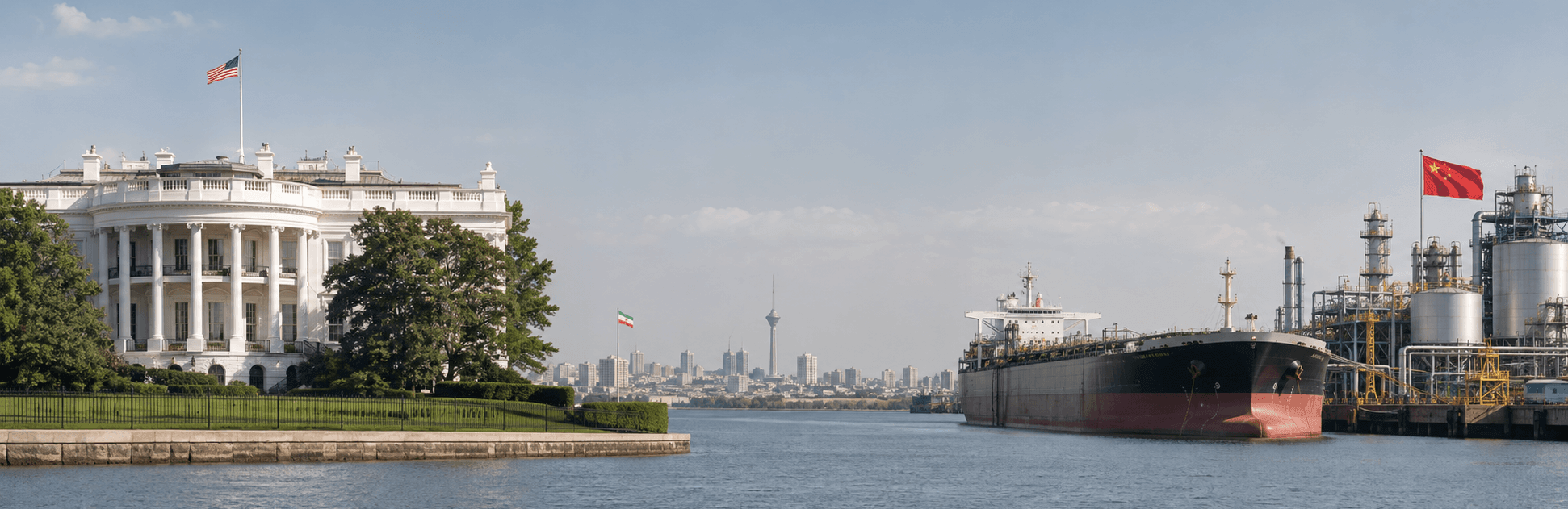
The United States is preparing a new sanctions package against Iran that Treasury Secretary Scott Bessent has described as the “toughest sanctions in history.” But the most consequential part of the policy may not be what it does directly to Iran.
The real test could be what Washington is prepared to do to the countries, banks, refiners and shipping networks that continue dealing with Tehran—especially China.
President Donald Trump has warned that countries providing Iran with “any type of lifeline” could face “tremendous economic consequences.” He referred not only to governments, but also to financial institutions, businesses, airports and other entities that might help Iran keep money, goods or oil moving.
That warning creates the possibility of a much wider confrontation. China bought more than 80% of Iran’s seaborne oil exports in 2025, according to Kpler data cited by Reuters. If the new measures reach major Chinese buyers or financial institutions, this stops being a conventional Iran-sanctions story. It becomes a direct test of American financial power, Chinese energy demand and the resilience of global oil markets.
Status note: As of publication, the U.S. Treasury has not released the final list of measures or targets. Claims about specific Chinese banks, refiners or shipping companies therefore remain possibilities—not confirmed elements of the package.
What has actually been announced?
Bessent said the details would be presented on Monday, 24 August, U.S. time. His description signals an expansion of Washington’s existing maximum-pressure campaign, but “toughest in history” remains the administration’s characterisation. It cannot be independently assessed until the legal authorities, designations, enforcement measures and exemptions are published.
What is confirmed is the administration’s intention to pressure more than Iran alone.
Trump’s warning was deliberately broad. It covered any country allowing its institutions or businesses to give Iran an economic lifeline. The examples he listed included oil smuggling, cash transfers, exchange houses, ship registries and front companies. These are the channels governments typically target when trying to restrict a sanctioned country’s access to international trade and finance.
The administration has not invented this approach from scratch. In April 2026, Bessent said buyers of Iranian oil—and banks holding Iranian funds—could face secondary sanctions. The U.S. Treasury has also previously targeted a Chinese independent refinery and dozens of firms and vessels connected to Iran’s oil trade and shadow fleet.
The unanswered question is how far the coming package will go.
Will it add more small trading companies and tankers to an existing blacklist? Or will it directly confront larger foreign refiners, banks, insurers, ports and shipping networks whose exclusion from the American financial system would carry far greater consequences?
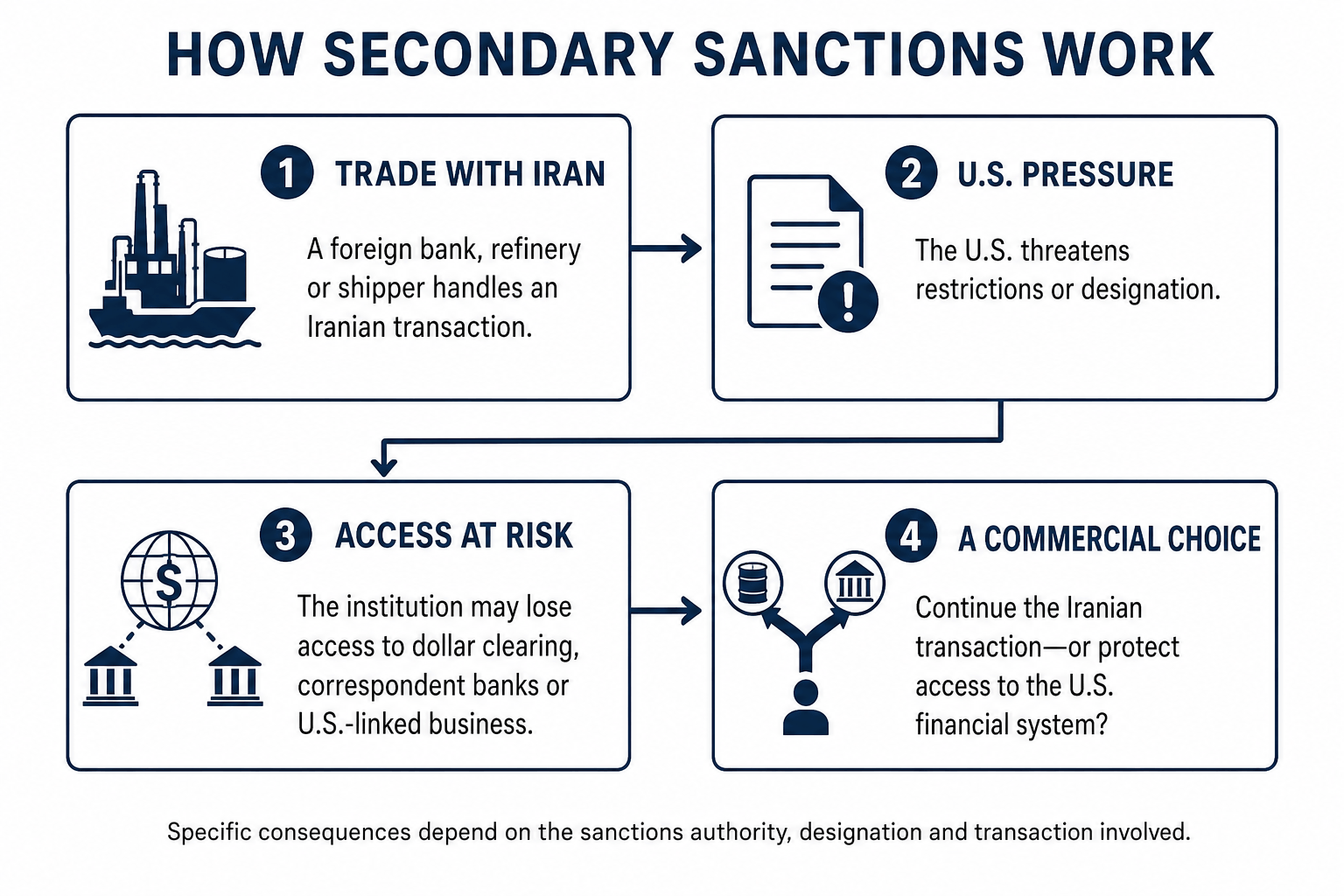
What are secondary sanctions?
Primary U.S. sanctions generally restrict American citizens and companies from dealing with designated people, businesses or sectors. Secondary sanctions apply pressure to non-U.S. entities by threatening consequences if they continue certain transactions with a sanctioned target.
The power comes from the central role of the United States in global finance.
A foreign bank does not need to be American to care about U.S. sanctions. It may still need access to dollar clearing, correspondent banking, American investors, international insurers or business conducted through U.S.-linked institutions. Washington can use that dependence as leverage.
In simplified terms, a targeted institution may be forced to choose:
Continue facilitating Iranian trade—or preserve access to the U.S. financial system.
That does not mean Washington can automatically stop every transaction. Trade can be rerouted through smaller banks, intermediaries, alternative currencies, opaque ownership structures and vessels operating through a shadow fleet. Iran has spent decades adapting to restrictions, while China has developed financial and commercial channels that are less exposed to direct American control.
But evasion is rarely cost-free. Sanctions can increase transaction fees, insurance costs, shipping risks and the discounts Iran must accept for its oil. They can also make large, internationally connected companies unwilling to participate, leaving trade concentrated among smaller entities with greater tolerance for risk.
Why China is the central question
China was not explicitly named in Trump’s warning. It is nevertheless the most obvious country exposed by the scale of its Iranian oil purchases.
Kpler data cited by Reuters shows that China accounted for more than 80% of Iran’s seaborne oil exports in 2025. That does not mean Iranian crude supplied 80% of China’s total oil demand. It means China received more than four-fifths of the oil Iran shipped by sea.
This distinction matters. Iran is important to particular Chinese refiners and trading networks, but China has a much broader and more diversified energy supply. Its crude imports also come from countries including Russia, Saudi Arabia, Iraq, Brazil and the United Arab Emirates.
Washington therefore has leverage—but Beijing has options as well.
China could reduce purchases, redirect some activity through less internationally exposed companies, demand deeper discounts from Iran, or openly reject the American campaign. The decision would depend on the exact sanctions, the entities targeted, the availability and price of alternative oil, and Beijing’s willingness to absorb economic costs in a geopolitical confrontation with Washington.
Bessent has publicly urged China to cooperate and argued that Beijing has an incentive to stabilise Gulf energy flows. China, however, has rejected unilateral sanctions as the solution and continued to advocate diplomacy.
This creates a difficult strategic balance. Measures weak enough to avoid a confrontation with China may fail to sharply reduce Iran’s oil income. Measures strong enough to threaten major Chinese banks or refiners could escalate an already tense U.S.–China relationship and disrupt energy trade.
Could America really cut off a major Chinese bank?
Legally and technically, the United States has powerful tools. It can block property under U.S. jurisdiction, prohibit American dealings with designated entities, restrict correspondent banking access and impose penalties on parties that facilitate prohibited transactions.
Applying those tools to a small refinery or shipping company is very different from applying them to a systemically important Chinese bank.
A major-bank designation could send shockwaves through trade finance and global markets. It could also invite retaliation against American companies operating in China, accelerate efforts to bypass the dollar, and create resistance from U.S. allies concerned about collateral damage.
That is why the identity and scale of the targets matter more than the administration’s headline description.
A long list of small entities may create enforcement pressure without fundamentally changing the market. Direct action against a major bank, refinery, insurer or port network would represent a more serious escalation. Until Treasury publishes the package, we should not assume which path Washington has chosen.
Iran’s warning raises the stakes
Iran has dismissed the coming measures and warned countries against assisting the American campaign. Iranian officials have suggested cooperation could be treated as hostile action and have raised the prospect of retaliation.
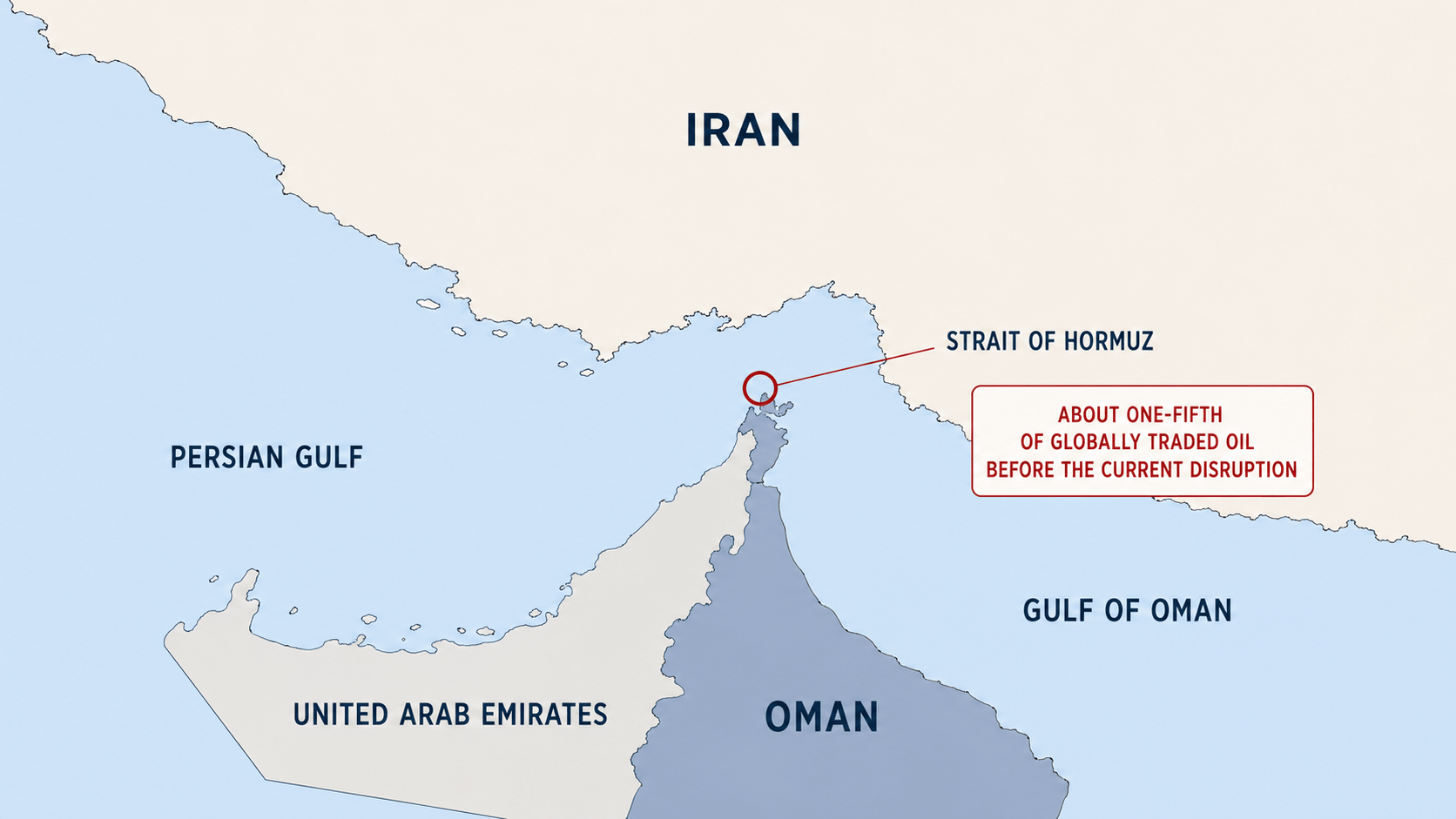
Those statements matter because the economic confrontation is unfolding alongside severe disruption to the Strait of Hormuz.
Before the current conflict, the strait carried roughly one-fifth of globally traded oil. Reuters reports that oil traffic through the route is now near a standstill. That disruption—not the sanctions announcement alone—is already exposing global energy markets to supply risk.
Iran’s ability to threaten shipping gives Tehran leverage, but using that leverage also carries enormous risks. Further disruption could damage the economies of Gulf states, increase costs for Iran’s trading partners, push oil prices higher and provoke additional international pressure.
Countries asked to support Washington are therefore weighing more than access to Iranian trade. They must also consider the possibility of economic or security retaliation and the broader consequences of a prolonged regional confrontation.
What could this mean for oil prices?
Sanctions do not mechanically produce one predictable oil-price outcome.
If the package substantially reduces Iranian exports while Hormuz traffic remains constrained, the supply outlook could tighten further. Buyers would compete for alternative barrels, shipping and insurance costs could increase, and the risk premium embedded in oil prices could rise.
If the measures mainly formalise restrictions that traders have already anticipated, the immediate market reaction may be smaller. Prices could even fall temporarily if the announcement is less severe than expected or if investors had already positioned for a harsher outcome.
Enforcement will be decisive. Sanctions that exist on paper but are routinely circumvented will have less effect than measures backed by active pressure on banks, insurers, ports and vessel operators.
The response from China will be equally important. A meaningful reduction in Chinese purchases would weaken Iran’s largest seaborne oil outlet. Continued buying—especially through institutions Washington is unwilling or unable to penalise—would reveal the limits of the campaign.
The real test comes after the announcement
The headline will focus on whether these are truly the toughest sanctions ever imposed on Iran. That may not be the most useful question.
The more important questions are:
-
Which entities and sectors are actually targeted?
-
Are major foreign banks, refiners, insurers or shipping networks included?
-
What exemptions, wind-down periods or licences are provided?
-
How aggressively will Washington enforce secondary sanctions?
-
Will China reduce Iranian oil purchases—or challenge the threat?
-
How will Iran respond if other countries cooperate?
America can make dealing with Iran more expensive and dangerous. Its financial system remains an extraordinary source of leverage. But China’s scale, alternative trade channels and strategic competition with Washington make this far more complicated than simply announcing another blacklist.
If Beijing refuses to stop buying Iranian oil, Washington will face a choice of its own: escalate against major Chinese institutions, tolerate continued trade, or negotiate a narrower outcome.
That is why the coming sanctions package may not ultimately be judged by the number of Iranian names it adds to a list. It may be judged by what the United States is prepared to do when the largest buyer of Iranian oil says no.
Sources
-
Reuters: Trump warns countries against providing Iran an economic lifeline
-
Reuters: U.S. warns buyers of Iranian oil about possible secondary sanctions
-
U.S. Treasury: April 2026 action against a Chinese refinery and Iran-linked shipping network
-
U.S. Treasury: February 2025 action against Iran’s shadow fleet