Proclamations signed on 8 September 2026 take effect for goods imported on or after that 29 September timestamp. The alcohol order covers listed Canadian beer, wine, whiskey, rum, vodka and other spirits in its annex. Parallel proclamations cover specified dairy and related goods, and motor-vehicle products.
Not every Canadian product is banned. Listed lines only. Do not confuse this with the separate 100% steel measures. Goods imported before 29 September but not yet entered for consumption, meaning not yet cleared into the U.S. market, stay under the prior 50% Section 338 duty rather than the ban.
TL;DR: On 29 September, listed Canadian booze, some dairy lines and some vehicle products lose U.S. import access under White House proclamations. BRP's Can-Am Spyder and Canyon three-wheelers from Valcourt, Quebec, face refused entry from that Tuesday, CBC reported. Spirits Canada says most Canadian spirits exports go to the U.S., so the hit lands on an industry already worried for months. This is a ban on listed lines, not a blanket Canada embargo and not the steel stack.
Status note: Checked 27 September 2026. Effective time is 12:01 a.m. ET 29 September for imports on or after that moment. Annex lists decide what is covered. "All Canadian goods banned" is false. Check the proclamation annexes for product scope.
What the alcohol ban covers
The White House alcohol proclamation excludes listed Canadian beer, wine, whiskey, rum, vodka and other spirits from importation into the United States. The annex is the legal list. If a product is not listed, this proclamation is not the tool that blocks it.
Spirits Canada has said most Canadian spirits exports go to the United States. That concentration is why industry groups describe months of concern, now topped by an outright exclusion for listed lines. Exporters who leaned on the U.S. channel lose the easy market path when the annex names their goods.
Retailers and distributors should read the annex, not a viral product photo. The proclamation language is about listed alcoholic beverages. It is not a free pass to invent which Canadian brands are covered.
Dairy and vehicles
Parallel proclamations cover specified dairy-related goods and motor-vehicle products. CBC reporting highlighted BRP: Can-Am Spyder and Canyon three-wheelers made in Valcourt, Quebec, refused entry from Tuesday under the vehicle measures.
Again, the word that matters is "specified." A dairy line or vehicle type not on the list is outside this ban, even if other Canada-U.S. tariffs may still apply. Buyers of Can-Am three-wheelers get a concrete example of how a motor-vehicle product proclamation shows up at the border: refused entry, not a polite extra duty sticker.
Treat annex text and the parallel proclamations as the authority for what clears or does not. News roundups are useful maps; the White House annexes are the gate.
Ban versus prior 50% duty
Timing creates a split treatment. Goods imported before 29 September but not entered for consumption remain under the prior 50% Section 338 duty, not the new ban. Entered for consumption means cleared into the U.S. market for domestic use. Section 338 is the tariff tool behind that earlier 50% duty layer.
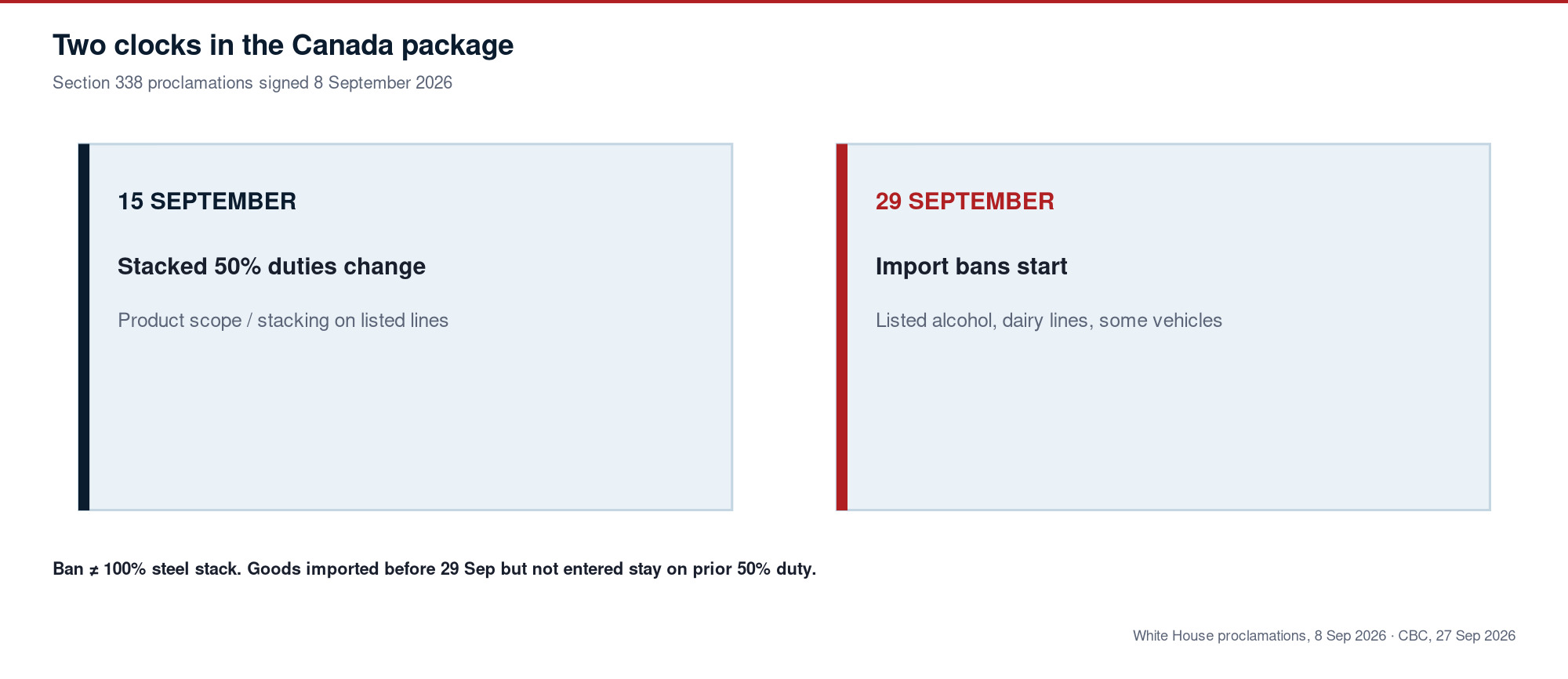
Importers and brokers will care about vessel arrival time, entry filing and whether the HTS line, the tariff code, sits on an annex. That operational detail decides duty versus refusal. Stock already on the water before the cutoff can still face the old 50% rule if it has not yet cleared. Shipments that import on or after 12:01 a.m. ET 29 September into a listed line face the exclusion.
That split is why "everything Canadian is banned tomorrow" fails twice. First, only listed lines. Second, pipeline goods can still sit under the prior duty track if they were imported before the timestamp and not yet entered for consumption.
What this is not
This package is not a claim that every Canadian product is barred at the border. It is not the same policy as a 100% steel stack discussed in other trade fights. Collapsing those stories misleads shoppers and buyers.
It is also not a quiet tariff that merely raises the price of listed booze while still letting it in. Exclusion from importation means refusal for covered goods in the ban window, not a higher duty sticker on the same entry path.
For U.S. retailers and Canadian exporters, the action item is boring and important: read the annexes, confirm the effective timestamp, and separate stock already in the pipeline under the old 50% rule from shipments that arrive into the ban window. Average readers need one breath: from 29 September, listed Canadian alcohol, some dairy lines and some vehicles are blocked at the U.S. border, and that is not the steel story.
Sources: White House alcohol proclamation; CBC News, 27 September 2026.